


Your Customers Are Comparing You to Two Other Companies. Do You Know Who They Are?
A homeowner sits down with three quotes spread across the kitchen table, reads reviews on a phone, and decides which company gets the job. Your business is one of those quotes, and the other two come from companies you may know only by reputation.
A local competitor analysis shows who sits beside you in that comparison and what the competitive landscape looks like through a customer’s eyes. This guide shows you how to find those companies and compare them on a one-page scorecard. You can do the whole process yourself, and if you want a second set of eyes, our local SEO team is ready to help.

Why Local Competitor Analysis Matters When Customers Compare Bids
Once a customer holds several bids, your business is judged against specific companies, so knowing who they are gives you a real advantage. Two questions show why.
What Is a Local Competitor Analysis?
A local competitor analysis is market research that reviews businesses competing for the same customers in the same area. It covers what they sell, how they price it, how customers talk about them, and how easily people find them online. The result is a set of competitor insights you can use to measure your own business.
How Many Companies Do Customers Compare?
Most customers compare more than one company. ArcSite’s homeowner survey of more than 1,000 people found that 95% get more than one bid, and most get three or more (ArcSite, 2022). That makes your business one of several choices, and often one of three, so it pays to know who the other two are.
How to Identify Competitors in Your Local Market
The companies customers compare you with may differ from the ones you expect, so build your list from search results and customer answers. Two steps do that: start with where to look, then sort what you find.
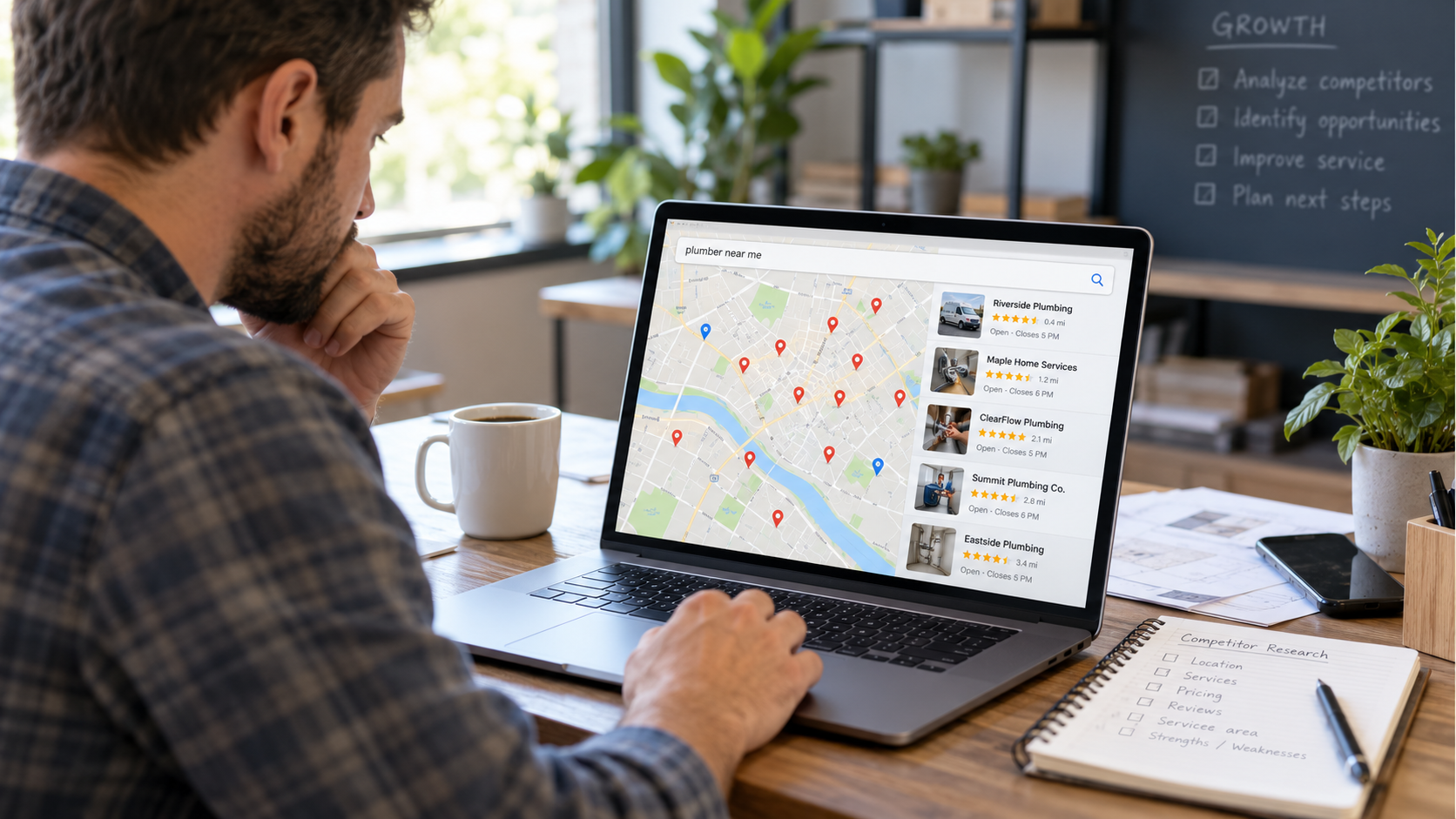
Start Competitor Research With Your Keywords, Google Maps, and Google Ads
Start with keyword research by choosing relevant keywords your target customers type, such as your service plus your city. Then note which companies appear in search results and on Google Maps, since local competitors sit beside you in local search whenever a customer starts looking. Repeat the search for each service you sell, because different search terms often surface different companies.
Additionally, paid search ads can reveal more companies, and once you spot an advertiser, you can look it up in the Google Ads Transparency Center. The tool lets you search by name or website and filter by date and location to see which ads it has run (Google, n.d.). You can also ask new customers which other companies they considered, which helps you find competitors you never would have searched for.
Sort Direct and Indirect Competitors Into Clear Groups
Once you have a list, sort each company into a group so you compare like with like. Direct competitors sell the same services in the same area, while indirect competitors offer something different that solves the same problem for your customer.
Direct competitors. Companies that sell what you sell to the same neighbors, such as another kitchen remodeler in your county.
Indirect competitors. Companies that solve the same problem another way, such as a cabinet refacing company when you sell full remodels.
Aspirational competitors. Industry leaders you’d like to match one day, even if they serve a bigger market than a small business like yours.
Keep the list to five to ten companies per keyword, since a longer list slows the analysis without adding much.
How to Compare Local Competitors Side by Side
Once your list is ready, a one-page spreadsheet keeps everything in one place, with one row per company and one column per point customers weigh. Four checks fill in most of it.
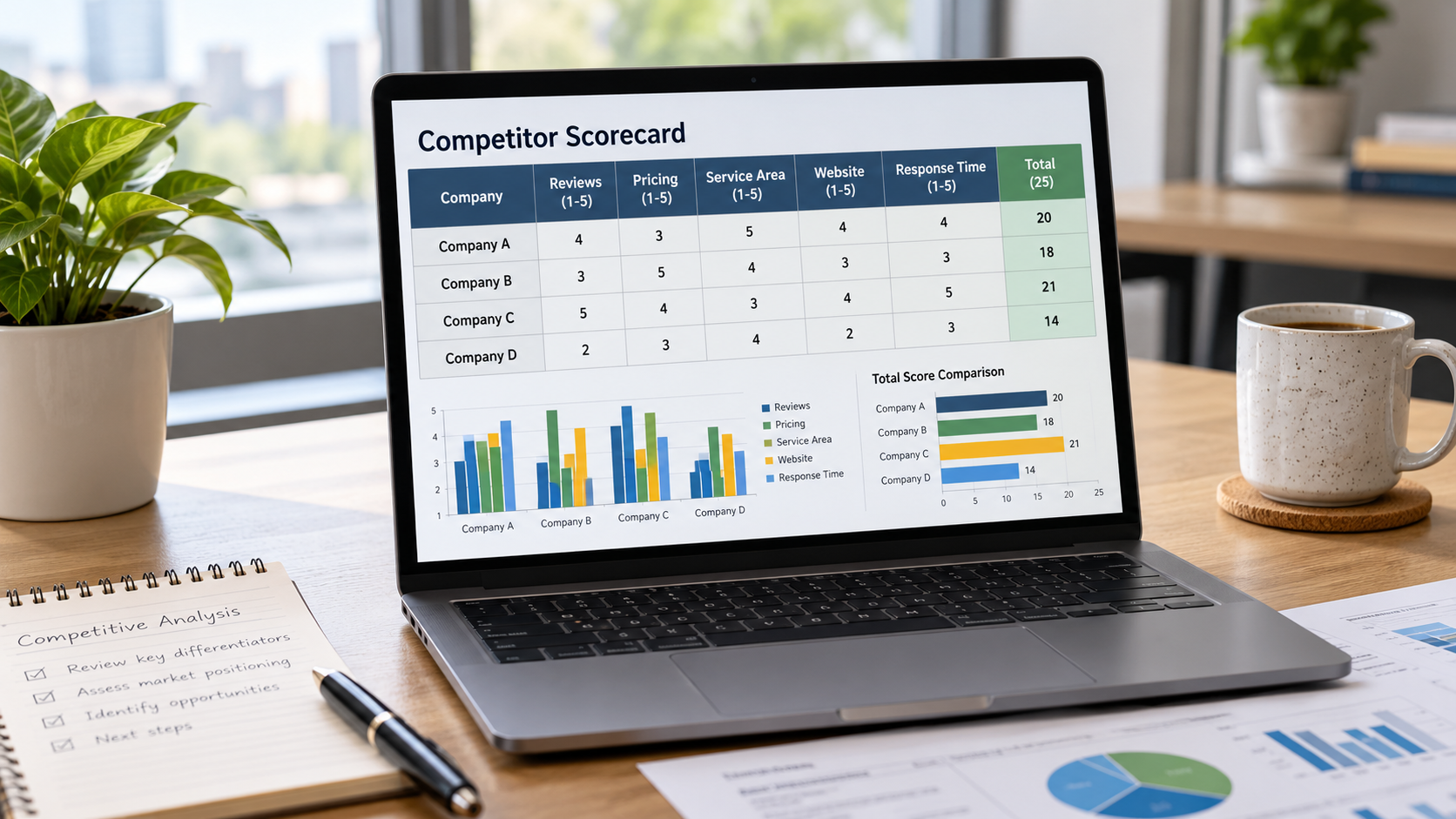
Compare Competitors’ Strengths, Pricing, and Competing Products
Start with the offer itself, since each company’s market positioning tells customers what it wants to be known for. Add one column to your sheet for each point below.
Services and core features. Note what each company highlights and which services it leaves out.
Pricing strategies. Record any competitors’ pricing you can find, such as starting prices, financing, or free estimates.
Competing products. List the materials, brands, or product lines each company promotes.
Competitors’ strengths. Write down what each company does best, such as fast response times or a strong warranty.
Review Google Business Profiles and Customer Feedback
Each competitor’s Google Business Profile shows its star rating, review count, photos, posts, and how often the owner replies, which together show how customers see that company. Reviews add detail, since customer feedback reveals a competitor’s strengths and weaknesses and the sentiment it has earned. Look for repeated pain points, such as late arrivals or unclear bids, because each one points to something you can do better.
Replies deserve a close look, too, since BrightLocal’s 2026 review survey found that 80% of consumers are more likely to use a business that replies to all reviews (BrightLocal, 2026). Half are also put off by generic, templated replies, so a row of identical answers is worth noting on your sheet.
If your profile trails the competition, Locallogy helps local businesses stay competitive with Google Business Profile management.
Study Competitor Websites and Social Media
Four quick checks show how each competitor presents itself online and how it treats a new customer. Add one column to your sheet for each check and fill in every company’s row. That lets you score them all on the same points later.
First screen. Open each website the way a new visitor would, noting the headline, photos, phone number, and next step, since how visitors judge a homepage decides whether they keep reading.
Search performance. Use SEO tools such as Ahrefs or Semrush to estimate each competitor’s organic search performance and website traffic, and to see which sites link to it.
Social media. Check what each company posts and how much engagement each post earns from its target audience, since social media activity hints at how well its marketing campaigns work across channels.
Sales process. Ask a friend to request an estimate from each company (a practice called mystery shopping), then note how quickly and clearly each responds.
Check Each Competitor’s AI Visibility in AI Search
Ask ChatGPT or another AI assistant to name the best companies in your trade and city, then record which names appear and how each one is described. A company that shows up in those AI answers has stronger AI visibility, and customers who ask an assistant for a shortlist may never see the companies it leaves out. Our guide to how AI picks local businesses explains the signals behind those answers, such as consistent listings, reviews, and clear website content.
How to Turn Competitor Analysis Findings Into a Competitive Advantage
A finished scorecard only helps when it changes what you do, so three habits turn each finding into a decision and keep the work current.
Score Your Competitive Analysis and Spot Opportunities
Score each key competitor from 1 to 5 in every column, where 5 means customers would see that company as clearly strong in that area. Then score your own business the same way.
Next, run a SWOT analysis on your own business, using what you learned about competitors to fill in your opportunities and threats. The comparison shows where you already lead and helps identify market gaps, meaning services or answers customers want that no competitor provides well.
Your scores also turn raw notes into strategic insights and give you benchmarks, so next quarter you can measure growth against the same companies and refine your marketing strategies.
Turn Each Finding Into One Action
Give every finding a single next step so the work doesn’t stall in a spreadsheet, and choose steps that match your business goals. The five below help you identify opportunities and outperform competitors.
Add a service to your website when several competitors offer one you leave out.
Answer a question your competitors leave unanswered in a page's first sentence so your content matches search intent.
Sharpen your unique selling point so your own brand stands apart.
Review your pricing against competitors’ pricing before the next estimate goes out.
Run a local promotion where competitors have little presence, so your marketing efforts reach customers they overlook.
Repeat the Analysis Every Quarter
Competitor analysis is an ongoing process that informs your business strategy because rivals change prices, photos, and offers, while market trends shift the questions customers ask. Repeat the scorecard every quarter, and set up Google Alerts for each competitor’s business name so new mentions reach your inbox without extra searching, which saves time for other tasks. A more thorough annual analysis keeps your business ahead as new companies enter the market.
Where Do You Stand Against the Companies Customers Compare You To?
After a few rounds of the scorecard, you’ll know which companies customers weigh you against and where you’re ahead or behind. That knowledge lets you fix weak spots and highlight real strengths before the next customer starts comparing.
If you would rather not run the first round alone, reach out to our team at Locallogy today, and we can help you build the scorecard and read what it shows.
Sources
ArcSite. (2022). 2022 homeowner survey report [Survey conducted by Researchscape]. https://www.arcsite.com/blog/2022-homeowner-survey-report
BrightLocal. (2026). Local consumer review survey 2026. https://www.brightlocal.com/research/local-consumer-review-survey/
Google. (n.d.). Ads transparency. Google Ads Policy Help. https://support.google.com/adspolicy/answer/13733850
Get the Latest Content in Your Inbox
Want to be the first to know about new content? Sign up to get our weekly blog posts sent to your email!