

People Aren't Googling You Anymore. They're Asking ChatGPT. Here's What Shows Up
Picture this: a homeowner needs a kitchen remodeler, a pest control company, or someone to fix a cracked foundation. Ten years ago, that search started with a Google query and ended with a scroll through blue links. Now it just as often starts with a question typed into ChatGPT, and the answer comes back as one or two names, not a page of options. The business named in that answer gets the call. Everyone else stays invisible, no matter how well they rank on a traditional results page.
This is generative search visibility. It's changing how local and service businesses get found, and sometimes that feels a little unfair if you've spent years doing everything right by old SEO rules. The good news is this shift isn't a mystery. It's already showing up in the traffic numbers.
And it rewards a set of signals almost any business can build with a bit of intention, which is the kind of work Locallogy does with clients every day.

What Generative Search Visibility Is and Why It's Happening Now
If you've never heard the term 'generative search visibility' before, you're not behind; you're just early enough to still have an edge. This section explains what generative search visibility means and why people are starting to ask AI assistants instead of typing into a search bar. It also covers how quickly this shift has taken hold.
What Is Generative Search Visibility?
Generative search visibility is how often, and how favorably, an AI system mentions a business when someone asks it a question. Instead of measuring where a page ranks on a traditional search results page, it measures AI search visibility directly. It tracks whether an AI assistant cites that business at all when a customer asks for a recommendation.
These AI assistants work differently from a search engine. Google scores and ranks pages, then lets a person click through and decide for themselves. An AI assistant skips that step. It reads across many sources, pulls out the specific facts and phrases that best answer the question, and writes them into a single response.
That means it isn't picking a "winning" page the way Google does. It's picking pieces: a service area from one source, a price range from another, a review comment from a third. A business only gets pulled into that response if its content contains something clear enough to extract: a specific answer, a specific number, a specific claim, not just a well-optimized page that ranks but never states anything concretely.
That's why a business can have excellent keyword rankings and still be missing entirely from the AI-generated answers an engine hands back. Ranking and being extractable are two different things, and AI assistants reward only one.
Why Are People Asking AI Assistants Instead of Googling?
People turn to AI-powered search engines because the answer arrives summarized, without ten tabs to compare late at night while trying to decide. A homeowner researching kitchen and bath remodelers doesn't want a list; they want a shortlist they can trust, and an AI assistant hands them one in a single response. For many home-improvement audiences, this is now the first stop, not the last resort.
Adobe's Digital Insights research found that 34% of consumers already use AI assistants for product research before they turn to a traditional search engine. That habit is growing fastest among people making bigger, more personal decisions like home improvement (Adobe Digital Insights Quarterly Report, 2025).
How Fast Is This Shift Actually Moving?
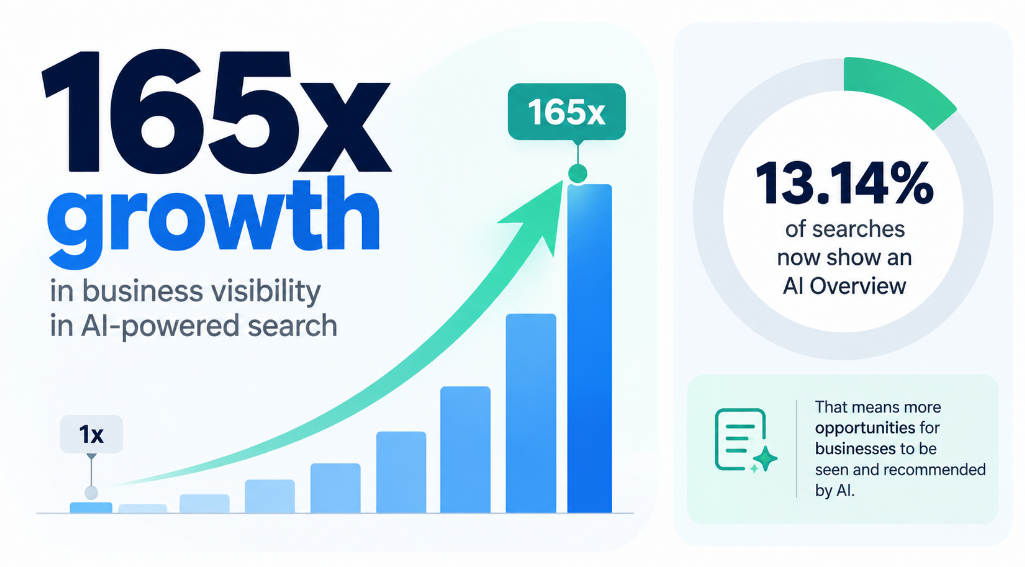
Most marketing trends creep. This one is sprinting. Generative AI search has grown 165 times faster than traditional search volume since January 2024, according to research published by Stagwell (Stagwell, 2025). That number can feel a little overwhelming at first read. Take it instead as an honest nudge. Businesses that wait for more data before adjusting their content are handing competitors a multi-year head start in an environment moving at that pace.
The Evidence This Shift Is Already Here
The claim that AI is changing how people search isn't guesswork. The numbers behind it are public, measurable, and honestly a little startling when you line them up.
Here's what's happening across search platforms and the AI models built on top of them right now, and what it means for a business's AI presence.
What Are Google's AI Overviews and How Often Do They Appear?
Google's AI Overviews are the summarized answers that now appear above traditional search results for many queries. They pull from multiple sources to generate a direct response instead of a list of links. They're one of the clearest examples of AI-powered search reshaping how people get answers. By March 2025, these AI summaries appeared in 13.14% of all tracked queries, more than double the rate from just two months earlier (Semrush, 2025).
What Is a Zero-Click Search?
A zero-click search happens when someone finds their answer directly on the results page and never visits a website. In 2024, 58.5% of Google searches in the United States ended this way (SparkToro, 2024). AI Overviews and AI assistants extend that same pattern.
For a business watching its own numbers, this often shows up as a slow, quiet dip in direct traffic, even when nothing else has changed. The business named in the answer benefits from the visibility. The ones left out don't get a second chance further down the page, because there is no page left to scroll.
How Much Traffic Are AI Platforms Already Sending Businesses?
Zero-click searches aren't the whole picture. Even though many AI interactions end without a click, the traffic that does flow from AI platforms is growing fast. Referral traffic from generative AI tools rose 123% between September 2024 and February 2025 (Search Engine Land, 2025).
That's a real, meaningful new channel opening up for local businesses. It isn't tied to domain authority the same way classic search rankings were. But it only shows up for businesses an AI system already knows to mention.
Are Blue Links Still the Reason People Search?
Search still exists to answer a question, and blue links were only ever one way of delivering that answer, never the point of the exercise. AI systems have simply gotten good enough to skip the list and go straight to AI answers where a scroll used to be. Three signals show how far that shift has already gone:
AI Overviews now appear in more than 1 in 8 searches, up sharply since the start of 2025.
Well over half of Google searches already end without a single click to any website.
Referral traffic from AI platforms more than doubled in under six months, often without any change in a business's ranking position at all.
None of this means traditional search engines are going away. It means a second, faster-growing channel now runs alongside them, and it plays by a slightly different set of rules, ones any business can learn.
Ranking vs. Being Cited — the Core Shift
Ranking and being cited sound similar. They're not, and the difference between them matters more than almost anything else here. Once that distinction is clear, everything that follows makes a lot more sense.
Some call this discipline generative engine optimization (GEO). Others call it answer engine optimization, or simply optimizing for how AI answers get built.
What's the Difference Between Ranking on Google and Being Cited by AI?
Ranking is about position on a search results page, decided by a search engine's ranking model. Citation is about whether an AI system chooses to reference a business at all when it builds its answer. That decision comes from something closer to a citation model, one that weighs trust and relevance over position.
A business can hold the top spot for its target keywords and still be absent from what ChatGPT or Google's AI Overviews say about local options. That's because these tools don't scan a ranked list. They synthesize a response from whichever sources they trust most.
Generative engine optimization is built to optimize for citations, not just position. Luckily, it's a genuinely learnable skill, not a mystery reserved for big brands with big budgets.
How Do AI Search Engines Decide Which Businesses to Recommend?
AI search engines pull from a mix of signals. These include how consistently a business's information appears across the web, what its reviews say, how clearly its website answers specific questions, and whether other sites mention it by name.
Where and how often a brand appears across these sources shapes every AI mention that follows. It builds the same brand presence most businesses already work toward through good local marketing. The difference is that a machine reads the signals now, not just a person scanning a page.
What Actually Makes a Business Visible to AI
Here's where things get practical. This section covers the specific, buildable factors that shape whether an AI system trusts a business enough to recommend it. It starts with the basics and works toward content optimization and AI optimization for the pages themselves.
Does a Business's Information Need to Match Across the Web?
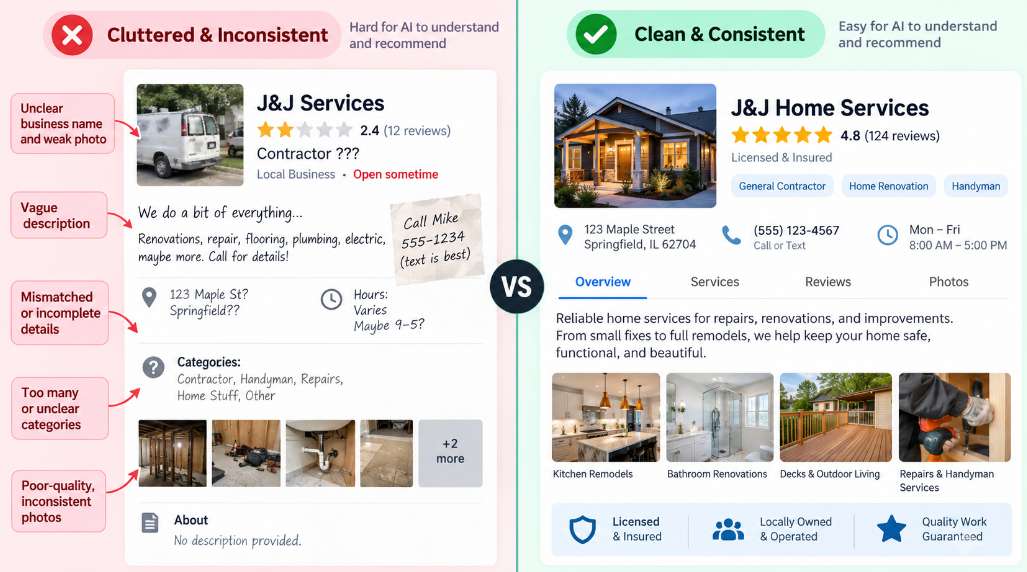
Consistency matters more than people expect, and it's one of the easier things to fix once you know to look for it. When a business's name, address, phone number, and service details match across its website, directory listings, and social profiles, AI systems treat that agreement as a trust signal. When the information is scattered or contradictory, the AI system has less reason to treat any single version as reliable, so it quietly moves on to a competitor.
Do Reviews Influence Whether AI Recommends a Business?
Review volume and sentiment carry real weight in an AI system's decision, which is genuinely good news for businesses that already treat their customers well. A business with a strong base of recent, detailed reviews gives an AI system something concrete to draw from. That helps it explain why one option might suit a customer better than another.
These reviews also function as a running stream of brand mentions in their own right, even before a single article or directory picks up the business. A thin or outdated review profile gives the AI system very little to work with, so it moves on to whoever has more to say.
What Makes a Page Easy for AI to Read and Cite?
This is where content structure becomes the difference between getting cited and getting quietly skipped. AI systems favor pages that answer a specific question clearly, rather than pages that talk broadly around a topic without ever getting anywhere concrete.
A handful of habits show up again and again in content that gets picked up:
Clear, descriptive headings that state what the section actually covers.
Direct answers placed early in a section, not buried under a long windup.
Structured data and semantic HTML that help a machine parse what a page is about.
Internal links connecting related service and location pages, so an AI system can see how content relates across the site.
Specific details, like a service area, a price range, or a named process, instead of vague marketing language.
Content that's kept current and covers a topic thoroughly, rather than a thin page written once and left alone.
Running a page through a generative engine optimization tool before publishing can catch a lot of these gaps early. A service and location page built around this kind of clarity tends to outperform a generic "About Our Services" page by a wide margin. It gives an AI system something exact to cite.
How Do You Write for the Question a Customer Would Actually Ask?
The starting point is the real question, phrased the way a person would ask it out loud, maybe even the way they'd ask a friend for a recommendation. Instead of writing around "kitchen remodeling services," a stronger approach answers "how much does a kitchen remodel cost in [city]" or "what's the difference between a full and partial kitchen renovation."
AI systems are built to match conversational queries to conversational answers. So content that mirrors real questions has a much better shot at becoming the source an AI system leans on.
Does It Help If Other Sites Mention a Business by Name?
Third-party mentions still carry weight, maybe more than they did under traditional SEO, and they tend to reflect something a business has usually earned already.
When credible external sources, industry directories, or local publications mention a business by name, that reinforces the entity signals an AI system uses to judge whether a business is legitimate.
It often resurfaces later in AI responses to related questions. A business that exists only on its own website has a much weaker case than one with a presence across several trusted platforms.
Where This Leaves Traditional SEO and What's at Stake
It's fair to wonder whether everything invested in SEO so far still counts. It does, and this section explains why, along with what's genuinely at risk for businesses that miss this shift.
Is Generative Engine Optimization Replacing SEO, or Working Alongside It?
Generative engine optimization complements traditional SEO rather than replacing it. Good on-page SEO and organic search fundamentals still matter, because an AI system draws on the same groundwork a search engine already trusts. GEO adds a second job on top of that groundwork: making sure the content is specific and clear enough for an AI system to lift and use in its answer.
What Happens to a Business AI Doesn't Recommend?
Staying invisible here has a real cost. As more people start their search with an AI assistant instead of a search engine, the businesses that do get mentioned pull further ahead, while the ones that don't get harder to find, right at the moment someone is ready to hire.
What Does This Look Like for a Homeowner Searching for Help Today?
Picture someone planning a kitchen remodel who opens an AI assistant and asks for local designer recommendations. The AI names two or three businesses and the homeowner calls one of them, often within minutes. Businesses left out of that answer never even get considered, no matter how good their work is. That's the whole stake of this shift, playing out in one ordinary evening.
Measuring Where a Business Stands Today
Before changing anything, it helps to know exactly where things stand. This section covers a simple way to check what AI systems currently say about your business, and how to keep monitoring it over time.
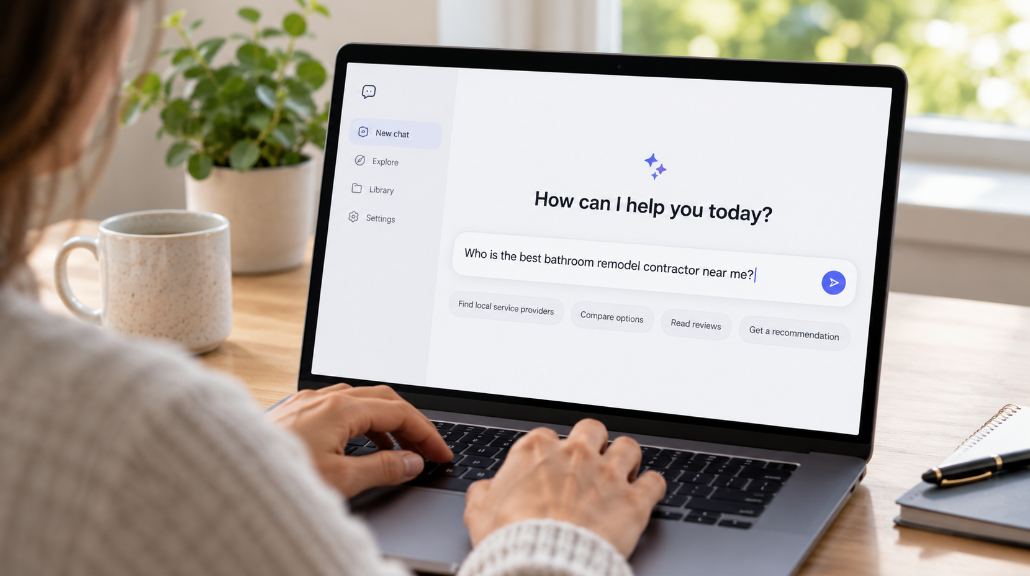
How Does a Business Check What AI Currently Says About It?
Before building a strategy, you need a baseline, and this part takes only a few minutes:
Ask several AI assistants (ChatGPT, Google's AI Overviews, and others) for recommendations in your category and city. Do this at different times of the day and on different days and start a new, clean chat each time.
Note whether your business appears at all, and how it's described when it does.
Compare that description against what your competitors get, and where the information might be coming from.
What Tools Help Track AI Visibility Over Time?
A one-time check is a useful starting point, but it only shows a single moment. As mentioned above, it’s best to do several checks on different days and times to get the clearest results.
A mix of third-party tools now measures AI citations and brand visibility across platforms on an ongoing basis, and standard Google Analytics data still helps by tracking organic and referral traffic from these newer sources. Businesses that check this regularly tend to catch a slip in visibility before it ever shows up as a drop in calls.
Does One Strong Page Beat Broad Coverage Across a Site?
A single well-optimized page can earn a citation for one specific question, but comprehensive coverage across a site tends to build more durable, lasting visibility. AI systems reward businesses that answer a wide range of related questions thoroughly, not just the one page that happens to rank well. Locallogy has written before about building content coverage rather than chasing a single keyword, and that same logic applies directly here.
How Do You Compare Visibility Against Competitors?
Competitive benchmarking is a different question: not whether a business's own content is thorough, but whether it's cited at all compared to the businesses AI systems do recommend. A visibility check like the one Locallogy runs for clients lays that comparison out clearly, showing exactly where a business stands next to its closest local competitors.
Turning This Into a Plan
None of this is meant to sit as theory. This last section pulls everything together into what a real strategy looks like, and the small, doable first steps that get it moving this week.
What Does a Real Visibility Strategy Actually Include?
A working visibility strategy pulls several pieces together rather than leaning on any one of them as a silver bullet:
Consistent business information across the website, directories, and social platforms.
A dependable flow of recent, detailed customer reviews.
Website content optimization built around direct answers, clear headings, and specific detail.
A presence on third-party sites and directories that reinforces credibility.
Ongoing measurement of AI visibility, not a one-time check and done.
A visibility strategy built around these components tends to hold up well as AI systems keep evolving. It's grounded in the same signals of trust and clarity these systems were already built to look for.
Where Should a Local Business Start This Week?
Getting started doesn't take an overhaul on day one, and that's genuinely reassuring. Three moves make the most immediate difference:
Run the AI visibility check above and write down exactly what shows up.
Audit business information for consistency across the web.
Rewrite one high-traffic service page to answer its core question directly, in the very first sentence.
Generate AI Visibility with Locallogy
Are you curious what AI assistants are currently saying about your business? Ask Locallogy to run an AI visibility check and get a clear, honest picture of where things stand today.
The businesses that show up in an AI assistant's answer aren't always the biggest names in a market. More often, they're the ones that made themselves easy to find, easy to trust, and easy to quote.
That's a fixable problem, and one worth fixing deliberately and soon, before more of the search happens somewhere a business simply can't be seen.
Sources
Adobe. (2025). Adobe Digital Insights Quarterly Report. Adobe Inc.
Search Engine Land. (2025, March 14). SMB websites see rising traffic from ChatGPT and other AI engines. Search Engine Land.
Semrush. (2025). Semrush AI Overviews study: What 2025 SEO data tells us about Google's search shift. Semrush.
SparkToro. (2024). 2024 Zero-Click Search Study. SparkToro.
Stagwell. (2025). Sloane accelerated discovery with generative AI strategy. Stagwell Inc.
Get the Latest Content in Your Inbox
Want to be the first to know about new content? Sign up to get our weekly blog posts sent to your email!