


Good, Better, Best: How Packaged Options Help Customers Choose and Help You Avoid Price Fights
When a customer holds two quotes that each show a single number, the lower number tends to win, since nothing else gives them a reason to choose differently. Many service businesses quote every job from scratch, so price becomes the only topic in the conversation and the only thing a customer can compare.
Offering a few clear packages gives customers more to compare than price, because each package spells out what the job includes. At Locallogy, we help local service businesses set up tiered service packages so customers can choose on more than price.
This guide shows you how to build three clear packages, name them in plain language, and display them without publishing a rigid price list. If your site needs a page for them, our web design team can build it.

Why Tiered Service Packages Help You Avoid Price Fights
Packages let customers compare your options instead of comparing your total to a competitor’s total. Four questions explain how that works, beginning with the pricing model itself.
What Is a Tiered Pricing Model, and How Does Volume Pricing Differ?
A tiered pricing model offers the same type of service in a few fixed levels, each with its own price point and what’s included. Volume pricing works differently because it lowers the per-unit price as quantity grows; for example, you get a discount for treating five properties for pests instead of one. With multiple tiers, customers pay more to get more value, so each step up is easy to compare.
What Can Service Businesses Learn From SaaS Companies?
SaaS companies made basic, standard, and premium plans familiar, and a service provider can borrow that structure for tiered pricing without the software details. Tiered pricing based on features or value suits most service work, since usage limits and unlimited access make little sense for a one-time job.
A free tier is also hard to offer when every visit costs you time. Recurring work such as pest control fits better, since subscription plans can offer priority scheduling in a premium plan and cover essential services in a basic plan.
How Does Customer Behavior Make Packages Easier to Choose?
Customer behavior favors packages for two reasons: first, customers change their choices as a project moves forward. In Houzz’s 2026 study of more than 20,000 homeowners, 37% went over budget.
Among those who went over, 35% chose higher-end materials than planned, and 31% changed the scope or design (Houzz, 2026). Packages let customers make those choices upfront at a known price.
Second, buyers tend to favor the middle of a set, a pattern called extremeness aversion (Simonson & Tversky, 1992). The research describes a tendency and carries no guarantee, so it supports a strong middle tier without promising a result.
What Are the Benefits of Tiered Pricing for a Service Business?
The benefits of tiered pricing start in the quote conversation and carry through to scheduling and revenue growth, as these five key benefits show.
Easier quote conversations. Customers compare your packages, so the conversation shifts to which one fits best.
A wider customer base. Diverse customer segments each find a package that fits, from budget-conscious clients on the basic tier to others on higher-priced tiers.
A clear path to upgrade. Each tier gives customers a way to move up as their needs grow, supporting retention and satisfaction.
More predictable revenue. Recurring plans with set prices make income easier to forecast and help maximize revenue.
Simpler planning. Standardized packages improve capacity planning and shorten the sales process.
How to Build and Show Tiered Packages Customers Understand
Creating tiered service packages takes four decisions, from how many packages to offer to where they appear on your site. Making each decision in order keeps the finished page easy to read.
Decide How Many Tiers to Offer
Three tiers are the usual choice because they give customers clear options without overwhelming them. In HVAC sales, a ServiceTitan advisor recommends offering at least three options so homeowners feel informed and don’t seek more quotes, according to ACHR News(Belloli-Oster, 2024). Start with three tiers, and add another only when a distinct customer segment needs it.
Build a Basic Tier, Then a Higher Tier That Earns Its Price
Each tier should include a specific set of benefits, so build them from the bottom up. Value-based pricing helps here, since it sets each price by what customers gain.
Basic tier. Cover the essential features and services, and price it to stay profitable while still reaching price-sensitive customers.
Standard tier. Balance value and cost, since the middle tier is often the one customers see as the best value.
Premium tier. Add advanced features, such as priority scheduling or a longer warranty, along with premium support, so the higher price feels fair.
In remodeling, tiers often follow product grades like cabinet lines or countertop grades, and the top tier package can bundle comprehensive solutions like design services.
Keep Distinct Tiers to Prevent Customer Confusion
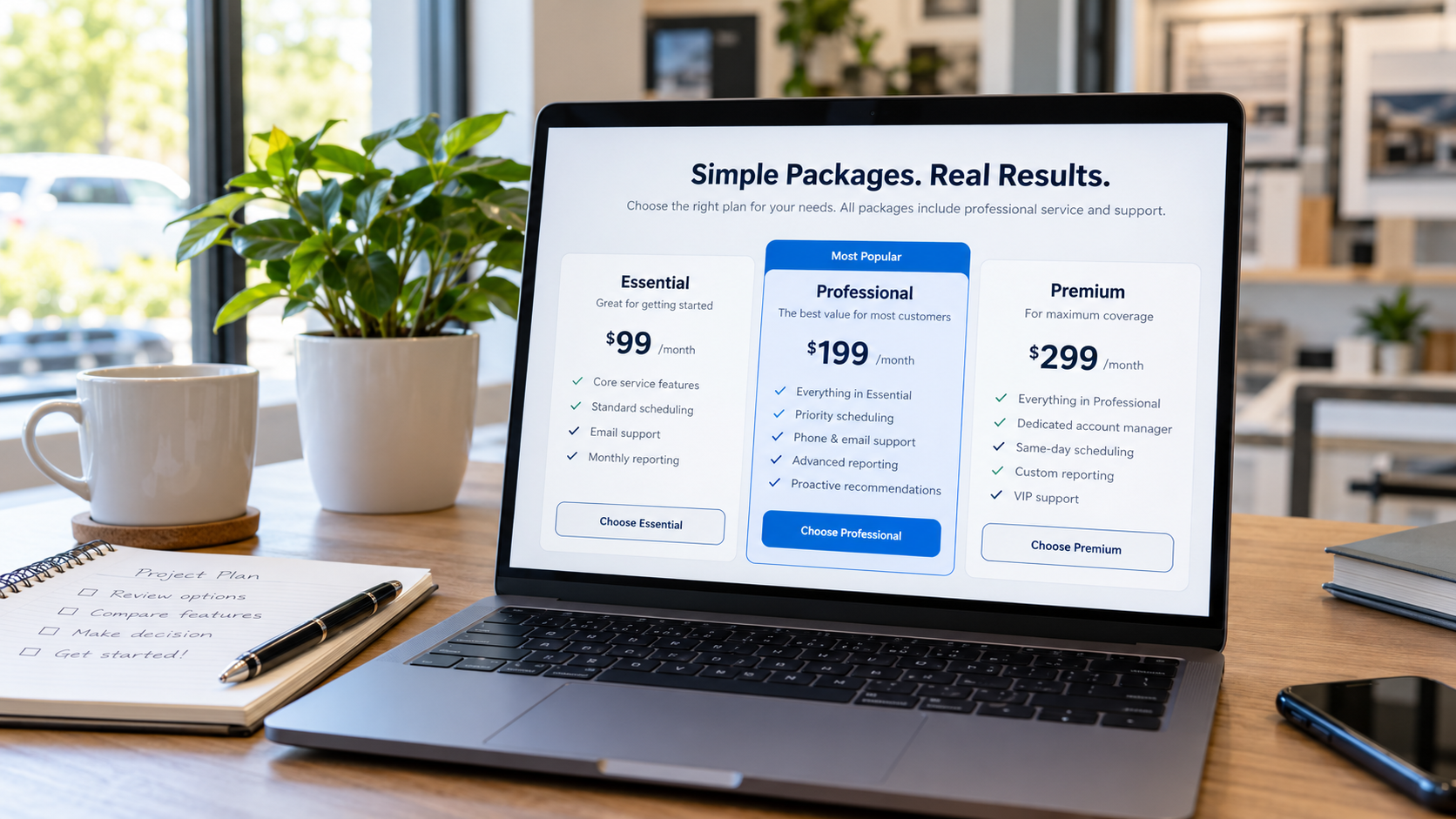
Distinct tiers differ by a reason customers can name, such as better materials or faster scheduling. Give each package a plain-language name, such as Essential, Preferred, and Complete, and write one line describing its value proposition. List the features side by side, since clear details build trust and show customers what they pay for, which prevents customer confusion.
Put the Packages on a Pricing Page Without a Rigid Price List
A pricing page can show your packages without fixed prices by using starting-at ranges, since the final cost still depends on the job. Placing the three packages side by side in a pricing table lets visitors see the differences at a glance.
A single sentence under each one can then explain what the next step up adds. Once your sales data shows which package customers choose most, mark it as the most popular to give new visitors a place to start.
People also decide quickly whether a page makes sense, so visitors judge a pricing page the same way they judge a homepage. Clear, answer-first writing helps there, too, and it gives AI assistants something to quote from your packages, as we explain in how AI picks local businesses. Finally, a short line on each package that explains what changes when customers move up a tier keeps upgrades simple.
How to Keep Your Tiered Pricing Strategy Working After Launch
Implementing tiered pricing is an ongoing job, since costs, products, and customer expectations change over time. Three habits keep the structure useful, starting with the mistakes to avoid.

Avoid the Mistakes That Make a Middle Tier Look Like a Trap
A middle tier looks like a trap when customers suspect it exists only to make another option look bad. These five mistakes create that suspicion.
Too many tiers. A fourth or fifth package makes customers compare more than they want to, so they delay or ask for a custom quote.
Vague differences. When customers can’t name what a step up buys, they choose the cheapest option.
A weak basic tier. A basic tier that can’t solve the problem pushes customers toward a higher tier they resent.
A premium tier with nothing extra. A top tier that only makes the middle tier look cheap erodes trust when customers compare the contents.
Hidden extras. Fees added after the choice make every tier feel like a trap.
Refine Your Packages With Sales Data and Customer Feedback
A quarterly look at your sales data shows which package customers choose most, so you can rework the tiers that rarely sell and leave the rest alone.
The numbers show what happened, but customer feedback explains why. Ask clients what they almost picked and why they chose their package, and you’ll see where the tiers' differences are unclear.
The same client feedback can also increase perceived value, for example, when a feature customers keep requesting moves into a higher tier. Once the tiers match what customers want, periodic checks of competitor pricing keep your price points realistic.
Get Help Presenting Your Packages Clearly
Tiered service packages give customers a reason to choose more than the lowest option, and a well-built page makes each reason easy to see. Once customers can compare your own options, the conversation turns to which package fits the job. If you want your services presented in clear packages, Locallogy can build your package page for your website.
Sources
Belloli-Oster, H. (2024, October 15). How to be the first and last quote a homeowner gets. ACHR News. https://www.achrnews.com/articles/155337-how-to-be-the-first-and-last-quote-a-homeowner-gets
Houzz. (2026). 8 home remodeling trends to watch in 2026 [Report on the 2026 U.S. Houzz & Home Study]. https://www.houzz.com/magazine/8-home-remodeling-trends-to-watch-in-2026-stsetivw-vs~184900562
Simonson, I., & Tversky, A. (1992). Choice in context: Tradeoff contrast and extremeness aversion. Journal of Marketing Research, 29(3), 281–295. https://www.gsb.stanford.edu/faculty-research/publications/choice-context-tradeoff-contrast-extremeness-aversion
Get the Latest Content in Your Inbox
Want to be the first to know about new content? Sign up to get our weekly blog posts sent to your email!