


The Five-Second Test: What a New Visitor Decides Before They Read a Word
Someone lands on your homepage right now. They haven't read a word yet, but they've already formed a first impression of your business. That impression happens in seconds, and it's often your only chance to get it right. It's more powerful and less forgiving than most business owners realize. The good news is that it's also one of the most fixable things about a current website, once you know what your target audience is actually reacting to.
What Happens in the First Few Seconds
Before we get into what to fix, it helps to understand just how fast this judgment happens, and how little of it is actually about your words on your website.
What Is a Website First Impression, and Why Does It Form So Fast?
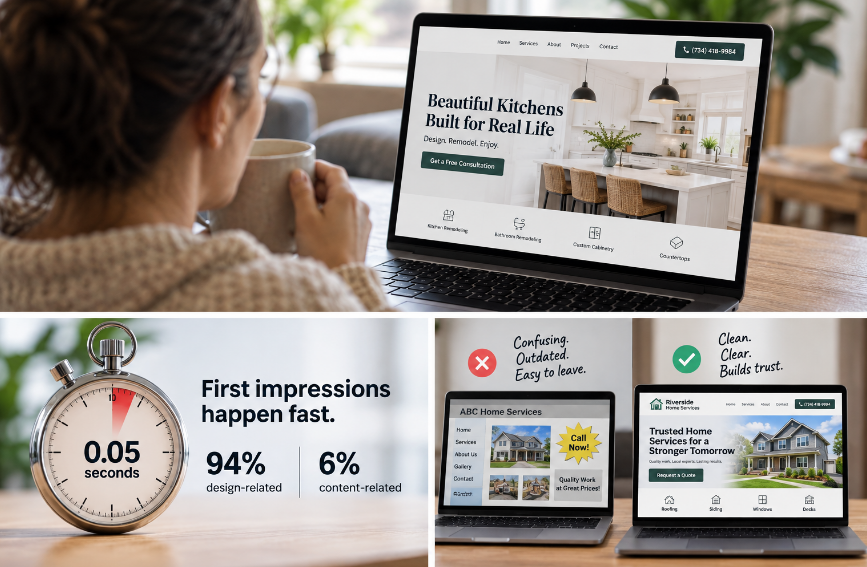
A website first impression is the snap judgment a visitor makes about your business before they've read anything. Research from Lindgaard and colleagues found that users form an opinion about a web page in around 50 milliseconds- that's 0.05 seconds- faster than a blink (Lindgaard et al., 2006). And 94% of that first impression is design-related, not content-related.
That means your headline, your service list, and your carefully written copy don't get a fair hearing until the visual layer has already made up its mind.
What Does a Visitor Actually Decide in Those First Five Seconds?
In those first few seconds, a visitor isn't reading; they're scanning. They're deciding whether your business looks legitimate, whether the site feels current, and whether it's worth their time. Seconds count here in a way few other business decisions ever face. If the answer feels like no, they leave before they ever get to the part where you explain why you're the right choice.
Part of why that snap judgment sticks so hard comes down to anchoring bias, our tendency to let the very first piece of information we get set the tone for everything that follows. A weak first impression becomes the lens through which a visitor reads the rest of your site, fairly or not.
Why First Impressions Matter More for a Considered Purchase
A quick, cheap purchase can survive a so-so first impression. A remodel, a new roof, or a pest control contract can't.
Why Do First Impressions Carry More Weight for a Remodel or Home Service Than a Quick Purchase?
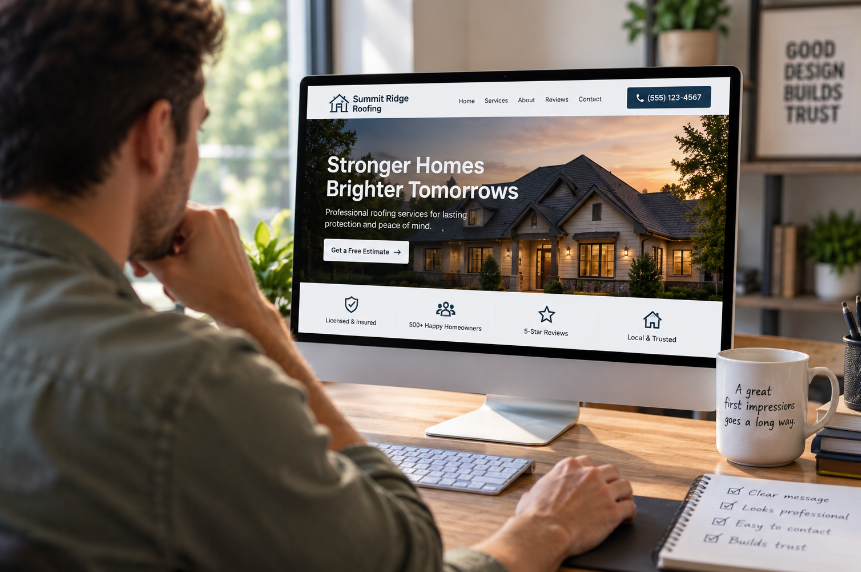
When someone is about to spend thousands of dollars and let a stranger into their home, trust matters more than almost anything else. You're not just selling a service; you're asking a potential customer to trust you with their biggest investment. A dated, cluttered, or confusing homepage undercuts that trust before you've said a word about your craftsmanship.
Stanford's Web Credibility Research found that 75% of consumers judge a company's credibility based on website design alone (Stanford Web Credibility Research). For a considered purchase, in a competitive marketplace full of similar-looking options, that number matters even more.
What Happens When a Website Undersells a Business That's Actually Great at Its Job?
This is the quietly painful part. A business can do beautiful, careful work and still lose the visitor before they ever see it, because the site didn't communicate that quality fast enough. The craftsmanship never gets a chance to speak for itself, and future interactions the business might have earned never happen.
What Builds (or Breaks) That First Impression
Once you know what visitors are reacting to, you can take a strategic approach instead of hoping for the best.
How Much Does Load Speed Affect a Visitor's First Impression?
Load speed matters more than most business owners expect. A slow site costs retailers an estimated $2.6 billion in lost revenue every year, industry-wide (Digital Silk, 2025). A fast site doesn't just feel more modern and professional; it also directly affects your search rankings and bounce rate, and it's one of the clearest industry trends to watch.
What Visual Cues Tell a Visitor "This Business Is Legitimate" at a Glance?
Visitors look for a handful of trust signals almost instantly: a clean layout, strong visuals instead of generic stock photos, visible contact details, and consistent colors and tone throughout the page.
Consistent visual branding alone can increase brand recognition by up to 80%, which matters if you're building a lasting brand legacy rather than a one-off impression.
Getting these key areas right, and telling your brand story clearly along the way, is exactly the kind of work our web design team focuses on for local businesses.
Can One Broken Link or Cluttered Page Undo Good Design?
Yes, and it happens more easily than you'd think. A few small things stand out fast to a new visitor:
A broken link or a form that doesn't submit.
A hero image that takes too long to load.
Contact details buried several clicks deep.
A homepage crowded with too many competing messages.
Visitors expect to find your contact information right on the homepage. Research shows 64% expect it there, and 44% will leave if they can't find it. One small friction point like that can undo an otherwise strong first impression.
The Five-Second Test You Can Run Yourself
You don't need special tools or a big budget to find out how your homepage is actually working. Sometimes a friend and a stopwatch are all it takes. Other times, it helps to have someone who does this for a living tell you what they see, which is exactly the kind of thing we help clients with at Locallogy.
How Do You Actually Run a Five-Second Test?
Here's the simple version:
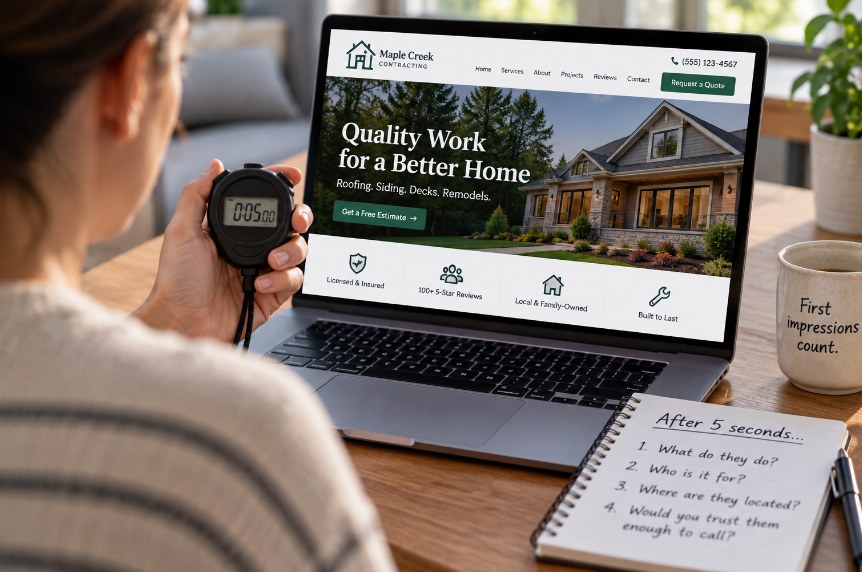
Show your homepage to someone who's never seen it, for five seconds only.
Take it away, then ask what the company does and who it's for.
Ask if they'd trust this business enough to call.
Note anything they hesitated on or couldn't answer.
Our co-founder often runs this exact test with new clients before touching a single design element, because it surfaces critical questions no analytics report can answer on its own.
What Should a Visitor Be Able to Tell You After Five Seconds?
After five seconds, a visitor should be able to say what you do, where you're located, and roughly why they'd choose you over the next search result. If they can't answer those, your homepage is asking them to work too hard for a strong first impression.
Turning a Good First Impression Into a Lasting One
A strong five-second impression is the start, not the finish line, but it decides whether anything else you've built gets seen at all.
What Does a Homepage Need to Get Right, Above Everything Else?
A handful of elements above the fold do most of the work to hook people and keep them reading:
A clear value proposition stating who you help and how.
A strong, compelling main image, not a generic stock photo.
Visible contact details and an obvious next step.
Social proof, like a review count or a trust badge.
Fast load speed and mobile-friendly design.
That last one matters more than it seems. Google found that 74% of users are more likely to return to a site that's mobile-friendly- one example of a small fix that helps a site work effectively for far more visitors.
A homepage built this way also gives you something worth sharing, in social posts, in referrals, in every future conversation about your work, because it finally matches the quality of what you actually do. Locallogy pairs strong design work with our local SEO experts, so your homepage isn't just fast and trustworthy; it's also found in the first place, building lasting engagement instead of a single quick visit.
Where Should a Business Start This Week?
You don't need a full redesign to start improving your odds. Run the five-second test with a friend this week, check your homepage's load speed, and make sure your contact details are visible without scrolling.
However, if you want to know what your homepage actually tells a first-time visitor, you can request a homepage review and get a clear, honest read on what's working and what isn't, in plain terms that make sense in any industry. So, although you never get a second chance at those first five seconds, you do get to decide, right now, what happens in them.
Sources
Digital Silk. (2025). Slow websites cost you millions in revenue. DesignRush.
Google. (2012). What users want most from mobile sites today. Google Mobile Ads Blog.
Lindgaard, G., Fernandes, G., Dudek, C., & Brown, J. (2006). Attention web designers: You have 50 milliseconds to make a good first impression! Behaviour & Information Technology, 25(2), 115–126.
Stanford Web Credibility Research. (2002). Stanford-Makovsky web credibility study. Stanford University.
Get the Latest Content in Your Inbox
Want to be the first to know about new content? Sign up to get our weekly blog posts sent to your email!