

AI Local Visibility: What the Data Reveals About Rankings
If you have checked your local SEO rankings recently and thought, “We’re still near the top, so we’re fine,” you are not alone. That logic made sense for years. It just does not explain the whole SEO picture anymore.
The 2026 AI Local Visibility report from Search Engine Land shows that Google AI overviews are appearing more frequently in local search results, often above traditional listings and even above Google Maps placements. In other words, what users see first is changing, and what users see first shapes what they do.
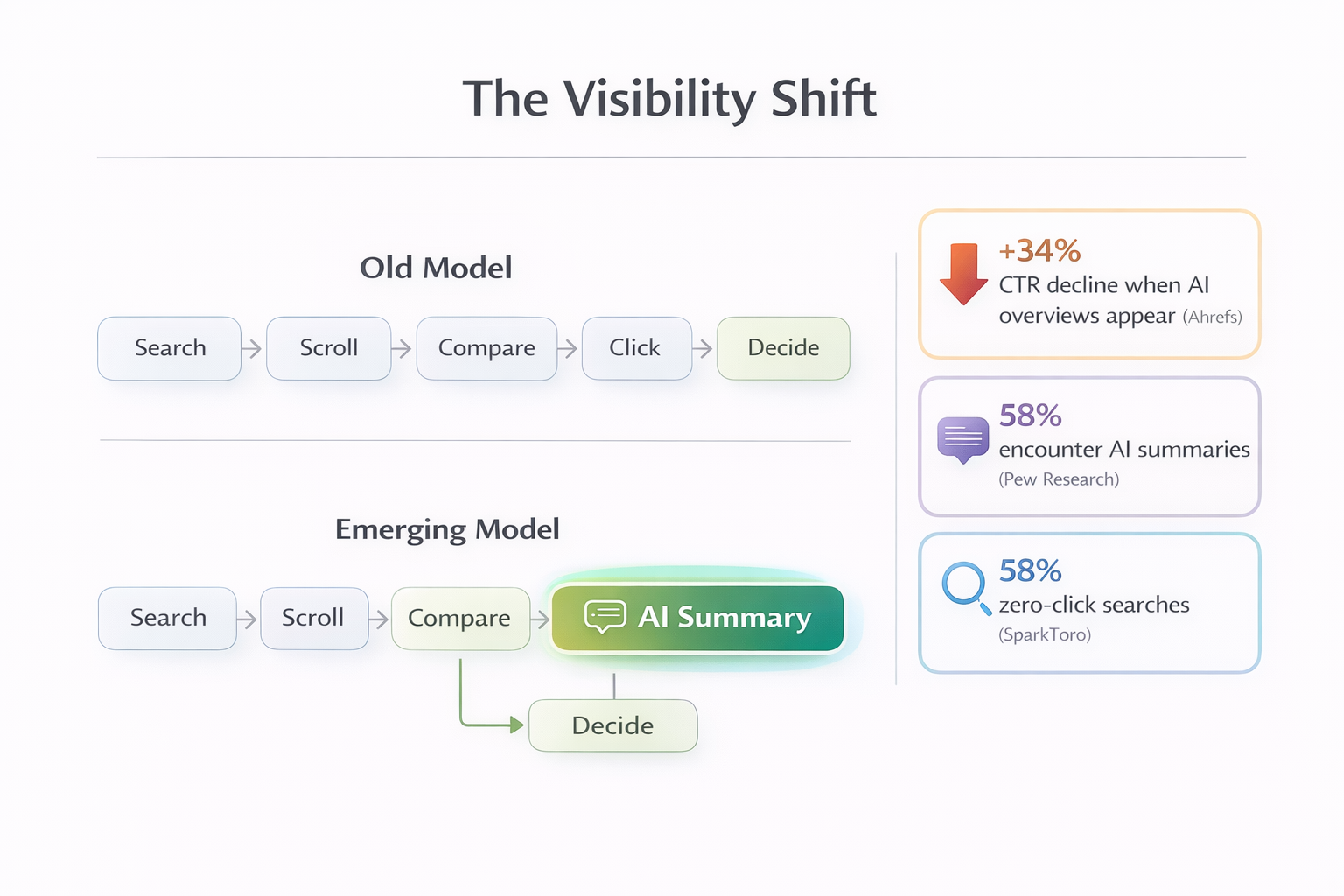
Independent research helps quantify the impact. Ahrefs found that AI overviews can reduce click-through rates to organic listings by roughly 34 percent when present. Meanwhile, Pew Research reports that 58 percent of users have encountered AI-generated summaries, and those users click on traditional links less often beneath them. Taken together, the data points to a clear shift in how visibility works.
So yes, traditional SEO and rankings still matter. However, AI local search visibility now operates alongside them. As a boutique agency focused entirely on local growth, we pay close attention to shifts like this because they tend to reshape competition. [va1] [ch2] In this article, we will break down what the data actually shows, what it means for local businesses, and how to think about visibility in a search environment that is becoming more answer-driven.
Seeing Local Visibility in Layers
When we talk about local visibility today, we are talking about two interconnected systems working at the same time. Thinking in layers makes the shift easier to understand.
Layer One: Traditional Local Search
The first layer is traditional local search. That includes Google Maps placement, organic rankings, and map pack performance. BrightLocal reports that 42 percent of users click on Google Map Pack results for local queries. This layer continues to drive meaningful traffic and revenue for many local businesses.
Layer Two: Visibility In AI
Then there is the layer of visibility in AI. This includes whether a business appears inside Google AI Overviews, Google AI summaries, conversational queries, and AI-powered recommendations across major AI platforms such as Gemini, ChatGPT, and Perplexity. This is where Google vs AI local rankings begin to diverge.
How The Two Layers Interact
The Search Engine Land report notes that inclusion in AI-generated results does not strictly follow ranking order. This means a business may hold strong traditional search placement and still not appear in the AI summary.
In other words, the two layers operate on related signals, but they do not mirror one another. Strong visibility in traditional organic results or Google Maps does not automatically transfer into AI-generated answers.
Most users will never pause to analyze that distinction. They react to what appears first. If your brand is mentioned directly within the AI-generated answer or summary, it carries weight. If it is not surfaced in those results, it may not be considered at all. vv
Here is where the practical impact becomes clear.
We see this regularly when reviewing new client accounts. The rankings look strong on paper, yet visibility inside AI summaries and conversational responses are uneven. The clearest example is a business that technically ranks well in organic search but is not consistently cited within AI-generated answers.
Traditional Local Search vs AI Local Search
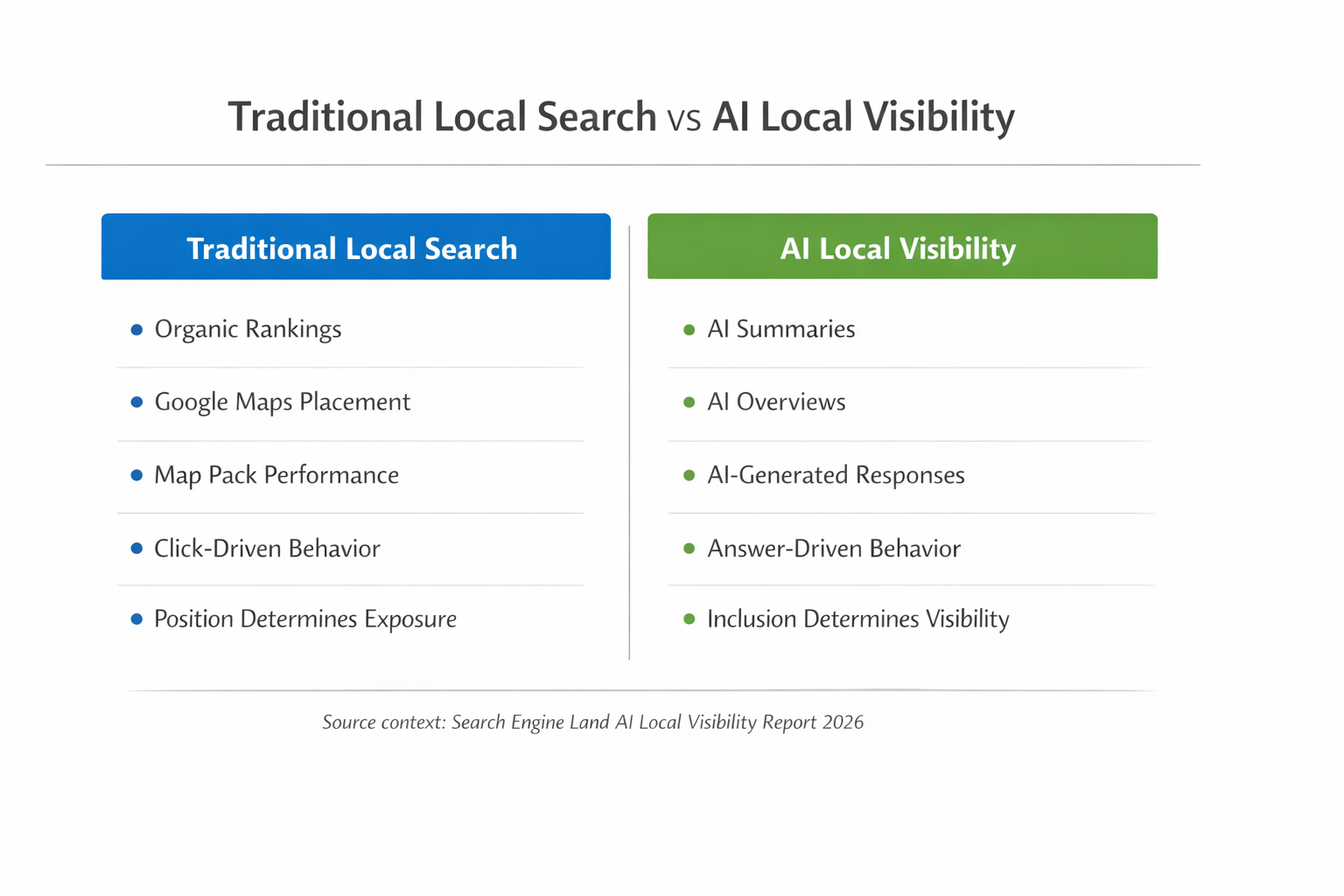
Traditional local search is based on ranked listings. SEO tools track keyword positions, map pack visibility, and geographic grid performance to show where your business appears for specific searches. This means a business's performance is measured by position.
AI local search works differently. Instead of displaying a ranked list of links, AI systems generate summaries and conversational answers. These responses may mention only a few businesses or combine information from multiple sources. Results can vary depending on how a question is phrased, and visibility may differ across platforms.
In short, AI local search visibility is about selection and not just ranking.
What This Shift Means for Local SEO Strategy
Local SEO strategy now requires a broader lens. This is where AI-powered local SEO enters the conversation.
Ranking performance still provides value, but it no longer captures the full picture of AI local visibility. Businesses must evaluate not only where they appear in traditional search results, but also whether they are included when answers are generated.
For local teams, the adjustment is strategic rather than dramatic. SEO efforts should continue to support rankings while also strengthening the clarity and consistency of the signals that influence inclusion. That includes maintaining accurate profiles, structured data, cohesive service messaging, and consistent information across platforms.
How Search Behavior Is Quietly Changing
The rise of AI local visibility would matter less if user behavior remained the same. It has not, and this behavioral shift is accelerating the impact of AI local search visibility.
In the past, local search typically involved scanning a list of options, comparing several businesses, and clicking through multiple websites before making a decision. Today, that process is becoming shorter and more direct.
Instead of browsing broadly, many users now:
- Read the AI-generated summary first.
- Focus on the few businesses mentioned within the response.
- Treat a synthesized answer as sufficient.
- Move forward without evaluating an entire page of listings.
This means most people are not thinking about search systems. They are trying to solve a problem quickly. If the response appears clear and credible, they act on it.
As a result, visibility inside AI-generated answers increasingly shapes which businesses enter into consideration at all.
How AI Systems Rely on Data Across the Web
If rankings do not determine inclusion inside AI-generated answers, what does? The answer comes down to how clearly your business exists as an entity online.
At the center of AI local visibility is something often described as entity strength. In practical terms, this reflects how clearly and consistently your business is defined across the web.
When AI systems can confidently interpret who you are, what you offer, and where you operate, they are more likely to reference your business in a generated response.
AI Systems Compare Information Across Sources
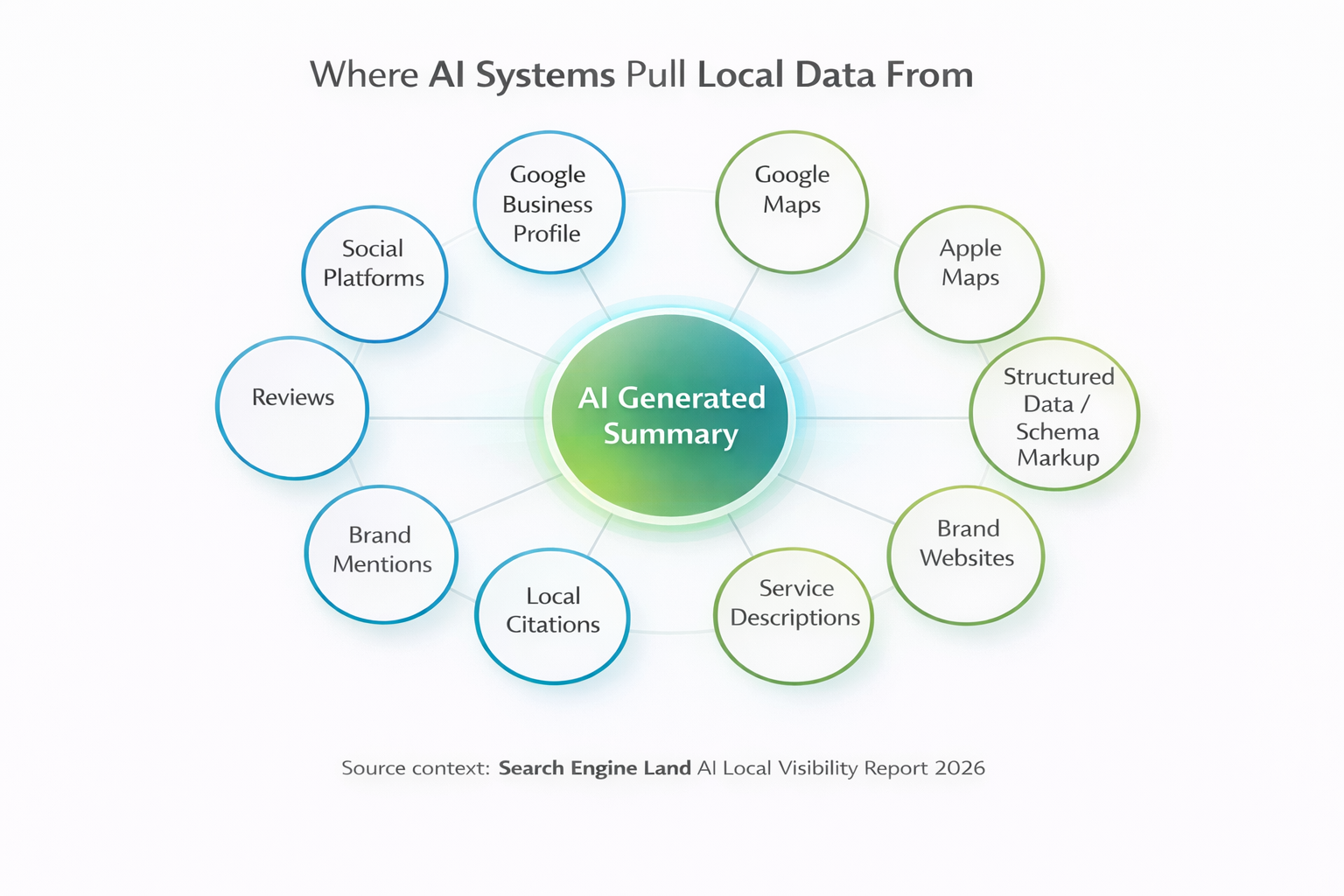
AI platforms do not evaluate a single listing or page in isolation. Before generating answers, they compare information across multiple sources, including:
- Google Business Profile and map data.
- Business websites and service pages.
- Structured data and schema markup.
- Reviews and third-party mentions.
- Social platforms and external references.
These signals are reviewed collectively. When information reinforces itself across platforms, the business becomes easier to interpret as a defined entity. When details conflict or appear incomplete, confidence is reduced.
Structured data plays an important role in this evaluation. Schema markup helps systems interpret services, categories, and locations in a standardized way. Clear service descriptions and accurate business details reduce ambiguity and strengthen how your business is understood.
To put it simply, AI local visibility reflects how well these signals hold together across the web.
How AI Systems Rely on Data Across the Web
If rankings do not determine inclusion inside AI-generated answers, what does? The answer comes down to how clearly your business exists as an entity online.
At the center of AI local visibility is something often described as entity strength. In practical terms, this reflects how clearly and consistently your business is defined across the web.
When AI systems can confidently interpret who you are, what you offer, and where you operate, they are more likely to reference your business in a generated response.
AI Systems Compare Information Across Sources
AI platforms do not evaluate a single listing or page in isolation. Before generating answers, they compare information across multiple sources, including:
- Google Business Profile and map data.
- Business websites and service pages.
- Structured data and schema markup.
- Reviews and third-party mentions.
- Social platforms and external references.
These signals are reviewed collectively. When information reinforces itself across platforms, the business becomes easier to interpret as a defined entity. When details conflict or appear incomplete, confidence is reduced.
Structured data plays an important role in this evaluation. Schema markup helps systems interpret services, categories, and locations in a standardized way. Clear service descriptions and accurate business details reduce ambiguity and strengthen how your business is understood.
To put it simply, AI local visibility reflects how well these signals hold together across the web.
How Multi-Location Brands Are Better Positioned For AI Visibility
The Search Engine Land report highlights a clear pattern in AI local visibility. Multi-location brands are appearing more consistently in AI-generated answers. A common factor is how their digital presence is structured and maintained across locations.
This helps explain why larger brands often surface in ChatGPT local recommendations and Gemini local search results.
Larger brands tend to build their online footprint with consistency from the beginning:
- Location pages follow similar frameworks.
- Structured data is implemented methodically.
- Google Business Profiles are actively managed.
- Service descriptions reinforce the same core information across markets.
This kind of alignment makes their digital presence easier for AI systems to interpret.
Essentially, multi-location brands often function as connected systems rather than separate, uncoordinated pages, which increases their likelihood of being surfaced in generated answers.
What about Local Businesses?
For independent businesses, the difference often comes down to how well their information connects across platforms.
AI visibility reflects how clearly your business is represented across the digital ecosystem. The more aligned and understandable that presence is, the more likely it is to appear when decisions are being shaped.
You don’t want to be like the many who still prioritize traditional ranking improvements without fully aligning descriptions, data, and references. After all, as AI-generated results become more common, businesses with stronger structural consistency are more likely to be included when answers are assembled.
New Types Of AI Search Are Changing Local Visibility
Local search no longer lives only inside Google’s traditional results page. Today, people search through AI Overviews, generative AI tools, voice assistants, and conversational platforms that deliver answers directly instead of showing a long list of links.
Here are some of the environments where local visibility now matters:
Voice Assistants
Tools like Siri and Google Assistant often provide a single spoken recommendation rather than a page of options.
AI Overviews
Google’s AI summaries appear above traditional listings and can influence decisions before users scroll as you know.
AI Chat Platforms
Tools such as ChatGPT, Gemini, and Perplexity generate conversational answers that may reference specific businesses and cite websites.
AI Agents And Task Assistants
Emerging tools that complete actions on behalf of users, such as booking or scheduling, may select businesses directly from synthesized results.
Because of this expansion, a business may rank well in Google Maps yet still be absent from AI-generated responses across other platforms
The opportunity is not to chase every new tool individually. It is to strengthen the foundations that help your website and brand be understood, trusted, and cited across environments.
Often, clear service descriptions, consistent data, structured information, credible mentions, and authoritative content increase the likelihood that AI systems can confidently reference your business.
Visibility Is Evolving and We Can Help at Locallogy
If AI systems are increasingly shaping decisions before users click, your visibility strategy must evolve with them.
At Locallogy, we can help your business adapt. As a boutique agency focused on local digital marketing, we use Local Visibility Index tools alongside other SEO techniques to evaluate how your brand appears across traditional search, AI overviews, and conversational platforms.
While no agency can guarantee visibility inside AI-generated results, we can identify where alignment breaks down. We can then strengthen the signals that influence how your website shows up and is cited by AI.
If you want to understand how AI local visibility is shaping your business, book a free consultation with our team. We will walk you through how your brand is being interpreted across search environments and where strategic adjustments can improve your presence.
Get the Latest Content in Your Inbox
Want to be the first to know about new content? Sign up to get our weekly blog posts sent to your email!