

Your Online Reputation Is Your First Impression: A Local Business Owner's Guide to Managing It
Most small business owners learn about online reputation management the slow way. A customer mentions a bad review in passing, your phones go a little quieter than usual, or a competitor pulls ahead in search rankings for no obvious reason. By the time online reputation management small business concerns start feeling urgent, the damage has often been settling in for weeks, sometimes months.
Here is the good news. Your reputation is something you can actively manage with a small set of habits, and the work is more straightforward than most owners expect. That matters because roughly 85 percent of consumers say they trust online reviews as much as personal recommendations from friends and family. At Locallogy , we have spent years helping local businesses get this right.
In the rest of this guide, we'll walk through why reputation matters more in 2026, where your reviews actually live, how to handle negative reviews without making them worse, where AI tools help versus where they backfire, and how to build a proactive system that feeds your local search performance.
Why Online Reputation Management Is Worth the Investment for Small Business Owners in 2026
The reputation game has changed, and not in ways that favor passive owners. Google's local ranking now leans more heavily on review velocity (how often new reviews come in), recency (how recent they are), and response activity than on profile completeness alone.
Organic click-through rates keep dropping, too, which leaves you with fewer chances to make a first impression and means the impressions you do earn have to work harder than they used to. That shift shows up in two places where most owners can quickly feel, and that is in the gap between believing that reputation matters and actually managing it, and the real cost of letting ratings slide.
The Gap Between Knowing and Doing
Most owners understand that reviews matter, but the follow-through is where the gap appears. We see this often with local businesses that deliver strong in-person service but do not have a consistent habit of turning that customer satisfaction into public reviews. Without that habit, strong ratings and recent positive reviews don't work as hard as they could before a customer ever reaches your website.
According to research published in the Journal of Small Business Strategy, 53 percent of small businesses do not actively manage their online reputations, and 60 percent never encourage customers to leave reviews. That creates a real opening. When so many competitors are still leaving reviews to chance, a simple habit of asking for reviews and responding to feedback can help your business pull ahead.
Is Online Reputation Management Worth the Cost for Your Business?
Industry data shows that a one-star drop in rating typically results in a 5 to 9 percent decrease in annual revenue, which makes your business's online reputation a measurable financial asset rather than a soft branding concern.
That figure is the right number to weigh against when comparing online reputation management costs. For a business doing several hundred thousand dollars a year, even a small rating drop can cost more in lost revenue than a year of professional small business reputation management would.
Where Online Reviews About Your Business Actually Live
Before you can improve your reputation, you need a clear picture of where customers are actually forming their opinions. Most owners track Google and maybe Facebook, which covers only a fraction of what your potential customers actually see.
Recent industry data backs this up, with one 2026 study finding that 62.6 percent of small businesses rely only on the review tools built into a handful of platforms they already use, which leaves customer feedback on every other site unseen and unanswered.
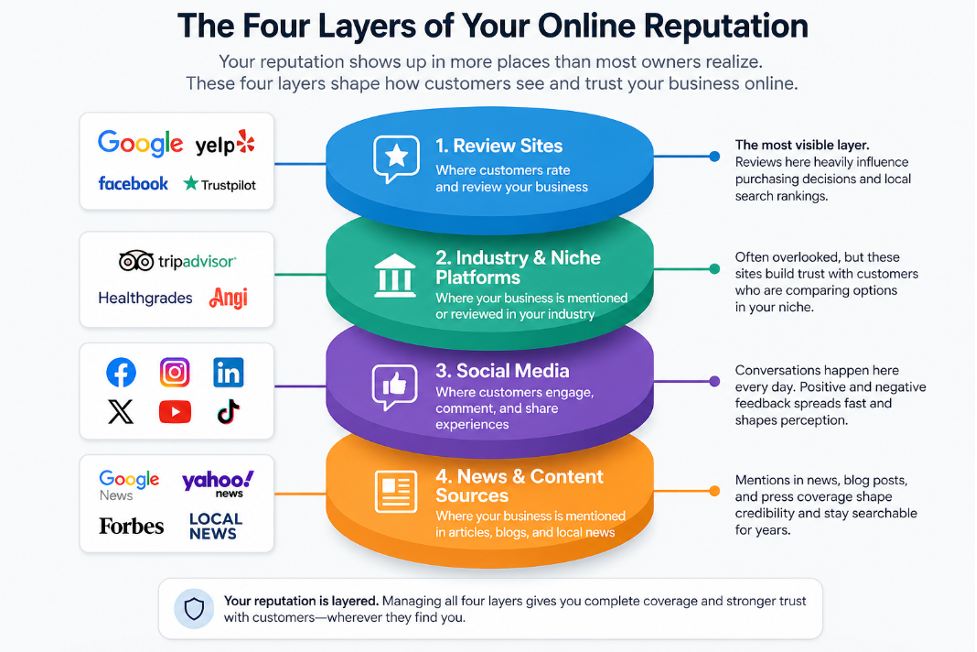
The Four Layers of Your Online Reputation
Your reputation actually spreads across four layers, and each one shapes your customer relationships in a different way.
General review sites. Google, Yelp, Facebook, and the Better Business Bureau. Most prospects check these first.
Industry-specific platforms. Angi and Houzz for contractors, Avvo for law firms, HealthGrades for medical practices, and TripAdvisor for hospitality. These often carry more weight inside their niche than Google does.
Social media. Customer mentions and tags on Instagram, LinkedIn, and TikTok shape how new customers perceive your brand before they ever search for it. That is why social presence has become part of a broader digital marketing strategy for local businesses.
News and forums. Articles, blog posts, and local forum threads that surface in search results when someone Googles your business name.
Online Reputation Management Tools That Cover All Four Layers
To manage your reputation across all four layers without missing key feedback, most small businesses need tools that help them monitor more than Google and Facebook.
The right online reputation management tools bring scattered reviews, mentions, and customer feedback into a more manageable workflow. Three tools are especially useful:
Google Alerts. Free brand-mention monitoring across news and blog content. This helps you catch early mentions of your business outside review platforms before they start shaping search results.
Reputation management software. Pulls feedback from multiple review sites into one dashboard, so managing customer reviews happens in a single workflow instead of six different tabs. This keeps responses consistent and ensures no customer feedback is missed or left unanswered.
Media monitoring services. With these services, you can catch the mentions that slip past keyword alerts, especially on niche forums and smaller publications. This gives you visibility into conversations that often influence customer perception but are easy to overlook.
However, even with the right tools, Google still anchors most local search journeys, which is why Google Business Profile management remains the foundation everything else builds on.
Once you know where your reputation lives, the next question is what to do when something negative shows up on one of those layers.
How Online Reputation Services Handle Negative Reviews the Right Way
A single negative review on page one of search results can cost your business 22 percent of potential customers before they ever reach your website. That is why the response under a review carries almost as much weight as the review itself.
Every prospect reading the thread is sizing up how you handle criticism, and they will form an opinion about working with you long before they pick up the phone. In our work with local businesses, this is often where future customers decide whether a company feels responsive, fair, and easy to work with.
The Wrong Way and Why It Costs You
Defensive replies do more damage than the original negative feedback, mostly because they reveal the business behind the response.
When you argue with the customer, shift blame, or deliver a long emotional explanation, you are telling future readers what working with you feels like when something goes wrong.
Here is what a response that hurts the business reads like.
"This review is completely unfair. The customer never told us about any issue while we were on site, and now they are trying to damage our reputation online. We have been in business for fifteen years and one bad apple is not going to define us."
The "fifteen years in business" line is meant to defend the company, but it actually signals that the owner takes criticism personally. That is the opposite of what your prospects want to see right before they decide to book with you.
The Right Way to Respond
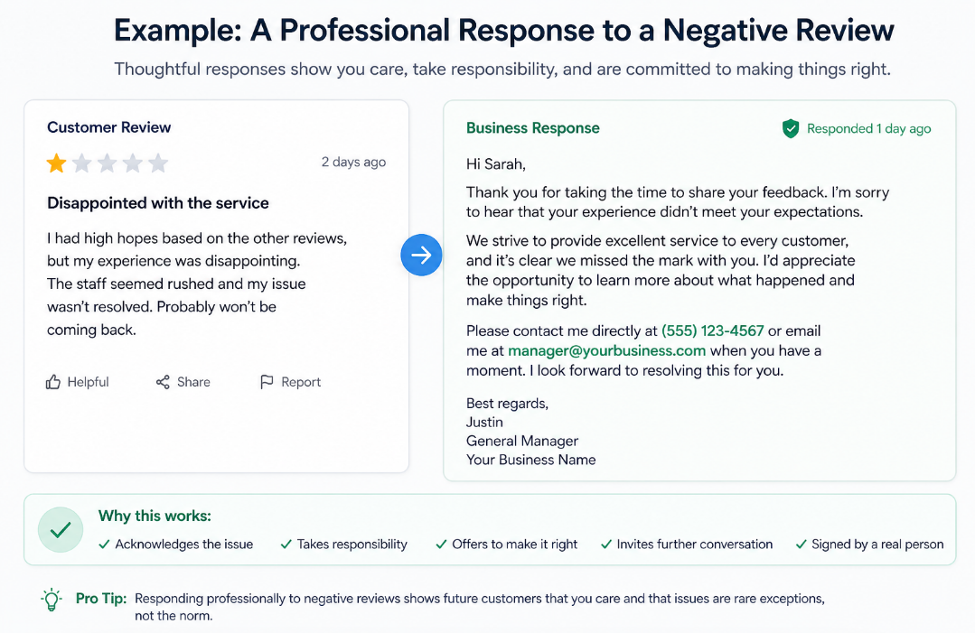
A measured response can build more customer trust than a glowing review ever will. The replies that work best are short, take real ownership, and point the customer toward a fix.
"Thanks for taking the time to share this feedback. We are sorry the project did not meet your expectations and we would like to make it right. I have sent you a direct message so we can sort out the next steps."
A few principles hold across most situations and turn this kind of reply into a habit rather than a guess:
- Respond within 48 hours so prospects see an engaged business.
- Keep replies to four sentences or fewer so the response does not amplify the complaint.
- Move the resolution offline so the public thread does not turn into a back-and-forth.
The same playbook works on Google, Yelp, or any industry-specific platform you are active on. Once you know how a good response should sound, the next question is whether AI can help you write those replies without making them feel generic or disconnected. That's what we're looking at next.
Why AI-Generated Review Responses Backfire on Search Engines
AI tools are genuinely useful for drafting review responses, but they can create problems when they are used without a human edit.
Generative AI use in local business discovery jumped from 6 percent to 45 percent in one year, which means more prospects are encountering businesses through summaries, review patterns, and quick comparisons before they ever click through.
That makes authenticity more important, not less. Customers can usually spot a templated reply within a sentence or two, which means the cost of getting this wrong has gone up.
Three Problems With Unedited AI Responses
Generic phrasing. AI defaults to language that could apply to any business online in any industry, which strips away the specific detail that makes a response feel real.
Brand voice drift. AI tools settle into a neutral corporate tone that rarely matches how your business actually talks to its customers.
Factual softness. AI cannot reference specific project details or staff members without prompting, so replies read as polished but disengaged.
How to Use AI Without Losing Your Voice
The fix is simpler than the problem makes it sound. Treat AI as a drafting partner, not the final voice, and add the two things AI cannot give you on its own.
Customer-specific detail. Bring in the project, the staff member, and what was actually promised, since AI does not know any of that.
Your business's natural voice. Edit until the reply sounds like how you would talk to that customer in person, not how a help-desk script would.
That editing layer is where online reputation management services and an experienced online reputation management company earn their keep. When you outsource the work to a partner, that partner handles the part AI cannot, which is exactly the work we focus on at Locallogy.
Drafting good responses is only half the work, though. The other half is making sure positive reviews keep coming in faster than negative ones, and that the whole effort ties back to your search visibility rather than running alongside it.
Building a Positive Reputation With Management Tools That Feed Local SEO
A proactive system breaks down into three habits that work together. You generate new reviews, catch problems early, and tie the whole effort to your search visibility.
Make It Easy for Satisfied Customers to Leave Positive Online Reviews
Most of your satisfied customers will leave a review if you ask, and most never get asked. Removing friction is the whole job, and the easier you make it, the more reviews you collect.
- Send a follow-up message within 24 hours of service completion.
- Include a direct link to the review platform you want to grow.
- Keep the experience short enough to finish in under 60 seconds.
Tools like Locallogy's Review Builder automate the request flow, so review generation no longer depends on remembering to ask after each job. It makes life easier, even if we are a little biased.
Monitor Weekly, Not in a Crisis
Weekly check-ins across your four-layer platform map, which we discussed earlier, can turn most reputation crises into minor adjustments before they escalate.
Catching a problem in week one is the difference between a quick fix and a months-long rebuild, and that alone is reason enough to put the time on the calendar.
Here is what a workable weekly check-in looks like.
- Block out a recurring slot at the same time each week so the work does not get pushed.
- Work through each layer of your platform map, top to bottom.
- Respond to anything new before the week closes, even if it is a quick acknowledgment.
Connect Reputation to Local Search Performance
Review velocity, response rate, and review recency all feed Google's local ranking signals, so they should be tracked alongside your other SEO data. That is what turns proactive reputation management into a visibility advantage. When reviews keep coming in, responses stay consistent, and recent feedback stays visible, reputation work and search work start reinforcing each other.
Plus, a consistent local business reputation strategy is now part of how local rankings are earned, not a side project. When you treat reputation as part of your local SEO services strategy, you are no longer waiting for complaints before you act. You are building trust, supporting search visibility, and strengthening customer relationships that become loyal customers.
Reputation Is a System and Not a Reaction
The pattern across every section of this guide is the same. Reputation management is operational work, not crisis work, and it pays off most for the business owners who actually stick with the system. When you run that system well, your business shows up higher in local search, earns trust faster, and recovers from individual bad reviews without losing momentum.
Of course, most owners do not have time to keep all of this running on top of the work that already fills the week, which is exactly the part you can hand off to us. Let Locallogy manage your online reputation so you can focus on running your business, and our team will handle the monitoring, the responses, and the search connection from one place. Get started with Locallogy today and see what proactive reputation management looks like when you have a partner in your corner.
Get the Latest Content in Your Inbox
Want to be the first to know about new content? Sign up to get our weekly blog posts sent to your email!