


The New Review Playbook: Why Multi-Platform Reputation Matters More Than Ever in 2026
A multi-platform review strategy used to be a nice extra for local businesses that had already mastered Google. However, in 2026, it has become the baseline. The average consumer now checks six different review platforms before choosing a local business, which means a reputation that lives only on Google leaves much of that research uncovered.
If your business has been treating Google reviews as the whole job, this is the year that approach starts costing you customers you never knew you lost. Don’t believe us? The numbers behind that change are hard to argue with.
BrightLocal’s 2026 Local Consumer Review Survey found that Google’s share of all online reviews fell from 83 percent in 2025 to 71 percent in 2026, while the use of AI tools like ChatGPT for local recommendations jumped from 6 percent to 45 percent.
Over the next few sections, we’ll look at where your reviews now live, why responding matters more than your star count, and how to streamline review management across every platform without overwhelming your team.
What Changed in Local Business Online Reviews Since 2023?
Reading online reviews before choosing a local business remains a firmly established consumer habit, with 97 percent of consumers still doing exactly that, according to BrightLocal’s 2026 Local Consumer Review Survey.
What has changed is how many places they look and how quickly they expect your business to appear across them. This means that a shopper who once glanced at a Google star rating may now open several review websites and weigh what they find on one against what appears on another.
That broader research journey is the main reason a multi-platform presence is no longer optional. But why? Well, two forces have pushed shoppers toward this wider search, namely trust and where searches begin.
Trust
Fake reviews have become easier to produce at scale with generative AI, while consumers often struggle to tell AI-generated reviews apart from those written by real customers, as research covered by the Associated Press has shown.
As a result, many shoppers no longer treat a single platform as the final verdict. Instead, they cross-check multiple sources to see whether the same patterns appear before committing. Reputation management, therefore, has to account for customer satisfaction as it appears across multiple sites rather than focusing on a single site.
Search Starting Point
Consumers now begin their research in more places than traditional review sites alone.
AI assistants, video platforms, and industry-specific sites each draw from a different pool of customer feedback, so shoppers may encounter positive reviews in one place, negative reviews in another, and a different view of customer sentiment elsewhere.
Because no single starting point provides the full picture, they are more likely to continue comparing sources before making a decision.
The Verdict
Together, those shifts leave local businesses with a broader reputation to manage. Google still matters more than any other platform, but a reputation that stops there covers a shrinking share of the places where purchase decisions happen. That is the gap the rest of this playbook will help you close.
Where Your Reviews Actually Live in 2026
As we said, Google remains the platform most consumers open first, hosting the majority of online reviews and setting the tone for everything that follows. It earns the top spot in any multi-platform review strategy, and no serious plan starts anywhere else. Yet the costly move is treating it as the finish line, since the other platforms in the mix carry real weight with specific audiences and industries.
Google Business Profile Comes First
Your Google Business Profile anchors your entire online reputation, since Google reviews appear directly in search results and Maps before a prospect ever reaches your website.
An active profile with recent reviews and prompt responses does more for local SEO and first impressions than any other single platform, which is why every other platform in your strategy builds outward from this one.
Facebook, Yelp, and Apple Maps Fill the Gaps
Once Google is handled, three platforms cover most of the remaining ground, and these are Facebook, Yelp, and Apple Maps.
Facebook reviews reach roughly half of consumers who check social platforms during their research; Yelp still carries authority in food, hospitality, and home services; and Apple Maps has nearly doubled in usage over the past year as more iPhone users lean on it for local search.
That last one is a rising priority that most businesses have not yet caught up with, making it an easy way to get ahead of competitors.
Industry-Specific Platforms Carry Extra Weight
Beyond the general platforms, the review site your own industry trusts can matter as much as Google. For example, Kitchen and bath and remodeling businesses live and die on Houzz, contractors get vetted on Angi, and healthcare practices are judged on Healthgrades.
These sites reach buyers when they are comparing specialists, so a thin presence on the one platform your category trusts can cost you the consultation before you ever hear from the customer.
This is the kind of gap our team at Locallogy flags first when we audit a client's business reviews, because it is so often the platform the owner forgot they had.
Video and AI Are the New Frontier
You should also know that the newest platforms are not review sites at all. Younger buyers increasingly check TikTok, Instagram, and YouTube for real-life opinions before they open anything traditional, while AI assistants pull from reviews across multiple platforms to build their recommendations.
That makes review coverage across several sites more valuable. Businesses with consistent, positive reviews in multiple places give AI tools more evidence to work with and give customers a more reliable picture of their reputation than businesses whose feedback is concentrated on one platform.

Why Responding to Every Review Now Matters More Than Your Star Count
Collecting reviews across all those platforms is only half of the job. The other half is review response, and this is where most local businesses leave the biggest opportunity sitting on the table. Unfortunately, consumer patience has shortened alongside the wider search, and 81 percent of consumers now expect a reply within a week, with a growing share wanting one the same day.
However, that expectation opens a gap you can use. Nearly 90 percent of consumers expect businesses to respond to reviews, yet only around 5 percent reply to every review they receive. A business that answers consistently, across both positive and negative feedback, stands out from a field of competitors who mostly stay silent, and those visible replies encourage customers to leave more reviews of their own.
Additionally, each kind of response earns its keep in a different way. For example, a thoughtful reply to a positive review reinforces what a satisfied customer already said and shows prospects the experience is real. Also, a calm, constructive reply to a negative review does even more, since it lets you address customer concerns in public and gives prospects a preview of how you would treat them.
Not to mention, one well-handled piece of negative feedback often builds more trust than a wall of flawless five-star ratings. This is because a spotless profile reads as staged while an honest mix reads as human.
How to Build a Multi-Platform Review Strategy Without Stretching the Team
If responding across every platform sounds like more than your team can handle, you are not alone. Many local businesses stay focused on Google because managing reviews across six platforms can feel like six times the work. In practice, it is often the same work organized more efficiently, and the four steps below turn that scattered effort into a repeatable review process.
Step One: Prioritize the Platforms That Matter for Your Vertical
Although a multi-platform presence is crucial, you don't need a presence on every review site. So, start with Google if you haven't already, then add the one or two platforms your specific customers actually use, and leave the rest until the basics run smoothly.
For instance, a kitchen and bath business gets far more out of Google, Houzz, and Facebook than out of a dozen scattered profiles nobody checks, so putting effort where your buyers already are keeps the workload sane. Additionally, multi-location businesses need a separate approach for each location, since each branch requires its own profiles and review generation rather than a single shared presence. This needs to be kept in mind as well.
Step Two: Centralize Monitoring So Nothing Slips
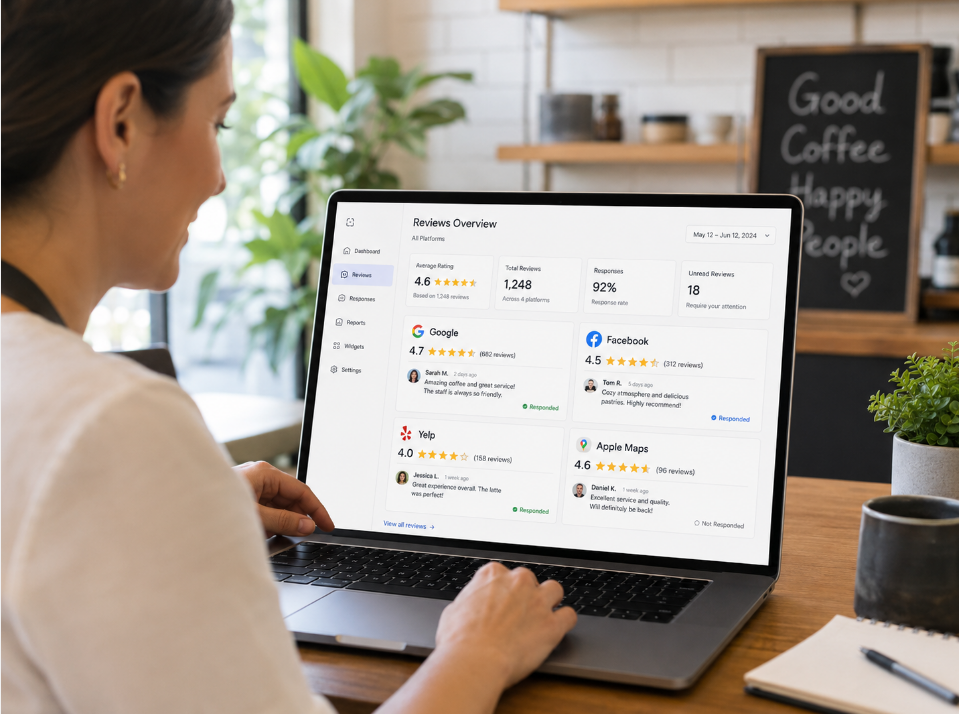
Watching six platforms, one account at a time, is where teams burn out, which defeats the purpose before you even start. A centralized online review management approach that pulls every new review into one place lets you monitor reviews, analyze reviews for sentiment, and respond from a single dashboard instead of logging in six times a day.
Some businesses run this through review management platforms or a dedicated review management system, while others hand the whole job to a partner. Either way, the goal is to pull all review data into a single view so patterns become easier to spot.
For instance, if customers raise the same issue across several platforms, it may indicate a broader service problem that needs attention before more people have the same experience. You can catch this in time and course correct.
Step Three: Automate Review Requests at the Right Moment
With monitoring in place, the next step is to increase review volume. One of the most effective ways to do that is simply to ask, since roughly two-thirds of customers leave a review when a business prompts them. A text or email sent within a day or two of finishing the job reaches people while the experience is still fresh in their minds.
Tools like Locallogy's Review Builder automate review requests, so encouraging satisfied customers to leave reviews requires no ongoing effort. They also let you rotate which platform you point people to, so your profiles grow evenly rather than lopsided.
Step Four: Respond on a Consistent Cadence
You do not need to respond to every review the moment it appears, but you do need a schedule that prevents feedback from sitting unanswered. So, set aside time each day or several times a week to work through new reviews from one centralized place.
A few basic response structures can also speed up the process without making replies sound copied. For example, positive reviews can be responded to by thanking the customer and referencing what they praised, while negative feedback calls for acknowledging the concern and offering a clear next step. You just need to determine what works best for you and go with it.

Build Your Online Review Management Strategy With Locallogy
Most local business owners keep a close eye on their Google reviews but have little sense of what customers see elsewhere. That gap matters as you've now learned because a prospect may find an outdated, incomplete, or unanswered profile on another platform and decide against the business before ever making contact.
Fortunately, we can help. Our team at Locallogy turns scattered feedback across platforms into useful review insights, audits the platforms that matter most to your business, and builds a multi-platform review strategy your team can maintain. So, send us your business name, and we will show you what customers are seeing across the places where they research you.
Get the Latest Content in Your Inbox
Want to be the first to know about new content? Sign up to get our weekly blog posts sent to your email!