

Why Email Still Beats Social for Local Service Businesses in 2026
Email marketing for a local business in 2026 outperforms almost every channel you probably spend more time worrying about. Social feeds move fast and paid ads climb in price every quarter, yet the email list keeps returning more per dollar than either one.
If you have been treating email as a newsletter chore while pouring your energy into social media, the numbers make a strong case for building a real email marketing strategy instead. The gap between the two is genuinely wide. Email marketing returns roughly $36 for every $1 spent, according to research from Litmus and the DMA, while paid search returns about $2 and social advertising about $2.80 on the same dollar.
This blog reframes email for the owners who think of it as an obligation. It walks you through why it beats social for service businesses, why your list is the one marketing asset you actually own, and the emails that reliably drive bookings. We're also exploring the metrics worth watching and how to grow your list without paying for ads.

Why Email Marketing Outperforms Social for Local Businesses
Social media carries a catch that you probably feel long before you can name it, which is that you are renting an audience you do not actually control.
Every time you post to Facebook or Instagram, the social media algorithms decide how many of your own followers ever see it, and that number has slid downward for years as the platforms nudge businesses toward paying for reach. This means realistically that you can spend a year building ten thousand followers and still reach only a few hundred of them on a good day.
Your email list turns that whole arrangement on its head, because a message you send lands in the inbox of every subscriber who has not unsubscribed, with no algorithm standing between you and the people who asked to hear from you.
That direct link is a big part of why 41 percent of marketers rank email as their most effective channel, compared with just 16 percent for social media. So, when your business runs on repeat customers and referrals, reaching everyone who opted in beats reaching a shrinking slice of followers on the social media platforms you will never own.
The economics only widen that gap. Where social feeds reward daily posting and usually some paid boosting just to stay visible, one well-timed email reaches your whole audience for close to nothing, and your email costs stay flat while ad prices keep climbing across your other marketing channels.
That flat cost is what turns time into an advantage, since every year your competitors bid up the price of paid reach, the list you already have gets comparatively cheaper without you spending an extra cent.
Your Email List Is the One Marketing Asset You Actually Own
The difference between renting and owning is the difference between social media and email. If Instagram throttles your reach or suspends your account over some violation you did not know you committed, the audience you spent years building disappears and takes your only way of reaching them with it.
An email list carries none of that fragility, since the addresses live in your own records and give you direct access to existing customers no matter what the social platforms decide to do next.
That independence has grown more valuable over the past year in a way you may not have clocked yet. The third-party cookies that once let businesses chase customers around the web with ads have largely disappeared, and Meta and Google keep narrowing what advertisers are allowed to target.
First-party data, meaning the details your customers hand you willingly, has become the sturdiest foundation you have for reaching people across all your digital channels. Your list is the purest form of it, which is why a strong local digital marketing plan now treats it as an asset that appreciates rather than a task to dread.
The Emails That Actually Drive Bookings
Ask most owners what email marketing looks like, and they will describe a monthly newsletter, but the marketing emails that actually put jobs on your calendar are simpler and more pointed than that. Four types carry most of the weight, and each one does a specific job:
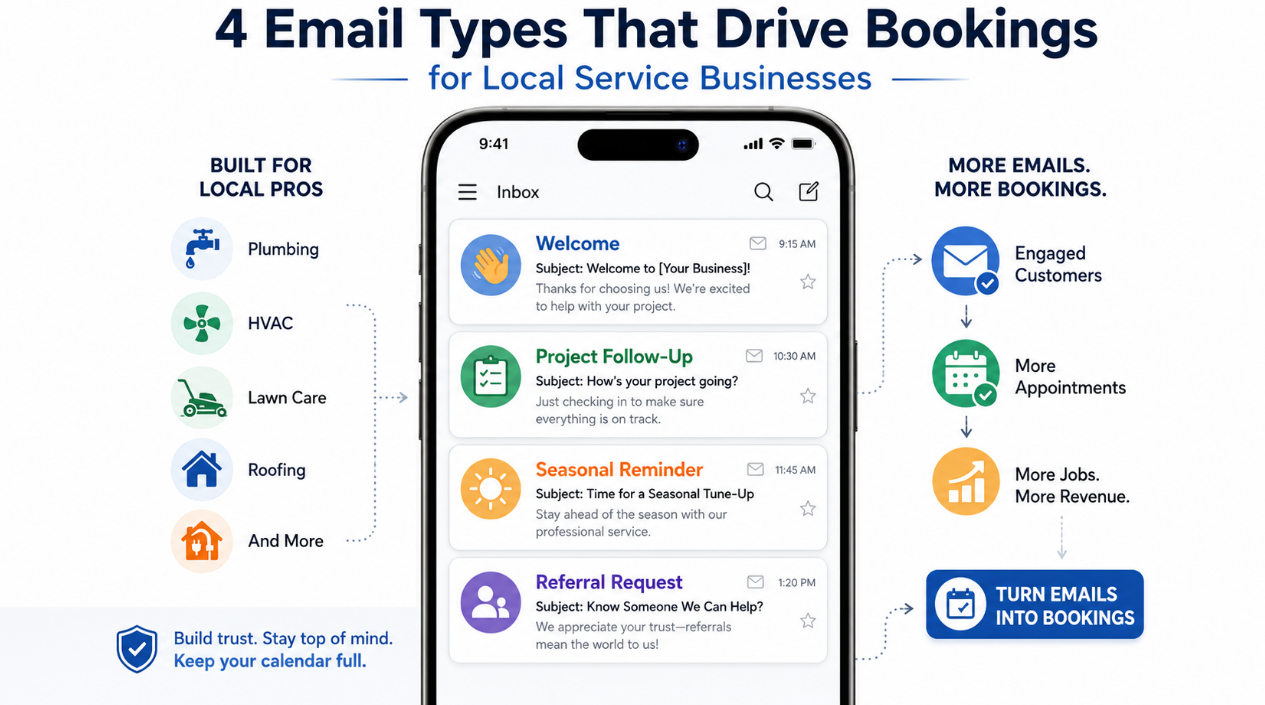
Welcome Emails
A new subscriber is never more curious about you than the minute they join your list, and a welcome email meets that curiosity while it is still piqued.
So, thank them, tell them what you will send and how often, and point them to a project you are proud of. That small note earns some of the highest open rates you will ever see and turns a brand-new contact into an engaged one before you have asked them for a thing.
Project Follow-Ups
Finishing a job well is only half the opportunity in front of you. A follow-up email a week or two later is what holds the door open for the next project.
It might be a lawn care client hearing from you before the first frost, a kitchen and bath customer nudged toward the bathroom they have put off for years, or a cleaning client offered a standing spot on your schedule. Since it reads as genuine follow-through rather than a sales pitch, it deepens the customer relationship and books work in the same breath, which is customer retention at its most natural.
Seasonal Reminders
Service demand runs on a calendar, and a reminder that lands right as the need surfaces feels less like marketing than like good timing.
A gutter company, for example, might email about fall cleanup in September, while a remodeler floats the idea of a holiday-ready kitchen in early autumn. When sent in the right week, these reminders turn your list into a booking engine that lines up neatly with your own busy season.
Referral and Review Requests
Your happiest customers are almost always glad to refer a friend or leave a review, and the only thing standing between you and that goodwill is usually the ask itself.
A short review request email pointing to your Google review page, or a warm thank-you offered for a referral, converts quiet satisfaction into repeat business and new paying customers alike. The reviews it earns then feed the reputation that wins your next prospect, so one small email keeps paying you back long after you send it.
The Key Metrics Every Email Marketing Strategy Should Track
Sending emails without watching the numbers is a little like driving with your eyes closed, but a few engagement metrics tell you nearly everything worth knowing. They fall into two tiers.
The numbers you check every send:
Open rates tell you whether your subject lines are earning attention in a crowded inbox.
Click-through rates tell you whether the content inside is actually pulling people toward action.
Unsubscribe rates warn you early when you are emailing too often or drifting from what people signed up for.
Local lists tend to beat national brand averages across the board, with higher open and click rates and fewer unsubscribes, because a neighbor who hired you actually wants to hear from you in a way a stranger on some giant retailer's list never will.
The numbers working in the background:
Sender reputation is the score email providers use to decide whether you reach the inbox or the spam folder, and it rises as people open and click.
Spam complaints pull that reputation down fast, which is why a clean, permission-based list protects every future send.
Local businesses will want to watch these as a pattern over time rather than fixating on any single email, since the direction your open, click, and unsubscribe rates move tells you whether your email is gaining traction or slipping.
That same view also shows you when a group of contacts has gone cold. A simple re-engagement campaign, one message asking whether inactive subscribers still want to hear from you, either wins them back or clears them out so your list stays healthy.
How to Grow Your Marketing Emails List Without Running Paid Ads
The belief that a good list demands expensive campaigns stops a lot of owners before they ever begin, and it happens to be flat wrong. The lists that hold up over years grow from the customers and prospects already moving through your day, gathered with just a little intention:
Add a signup form to your website. A simple form on your homepage and every blog post catches visitors who are interested but not ready to book, so you can stay in touch until the timing is right.
Ask at the point of service. Goodwill peaks the moment a job wraps, so asking for an email address then, with permission to send tips and seasonal offers, brings in engaged contacts who already trust your work.
Capture leads at local events. Home shows, community fairs, and sponsorships put you face to face with the exact local audience you want, and a quick signup sheet or QR code turns that conversation into a subscriber.
Offer something worth the address. A short remodel-planning guide or seasonal maintenance checklist gives people a reason to share their email, and it casts you as the expert well before they call.
Collecting those addresses is only worth doing if sending to them stays simple, and it usually does. Most email marketing platforms offer free plans that comfortably cover a small local list, with paid plans that start low as you grow, so none of this needs a new line in your budget.
The right email marketing platform for a service business handles the signup forms above, the basic automation that sends your welcome and follow-up emails on their own, and the mobile optimization that makes them look right on the phones where most people now read them.

How Email Fits Alongside Your Other Marketing Channels
Email works best when it anchors the rest of your marketing rather than competing with it. Most local businesses already spread their effort across several digital marketing channels, from social posts to paid search to the occasional round of direct mail, and each of those does its own job well without doing much to hold onto the people it reaches. That is the gap email fills, pulling those scattered touchpoints together and turning one-time attention into a relationship you can return to again and again.
You can see that role most clearly in the way the pieces feed each other. A social post or a paid ad brings someone to your website, a signup form turns that visitor into a subscriber, and from there your email campaigns keep the conversation going long after the ad budget runs out.
Additionally, direct mail can still earn its place for a big seasonal push, yet it cannot follow up on its own the way an email sequence does, and it never tells you who actually paid attention. Because email closes exactly those gaps, it ends up being the one channel able to capture and hold the audience your other digital marketing works so hard to attract.
Holding that audience pays off most when your channels speak with one voice, and that is where a little coordination goes a long way. When your email marketing efforts match the message you are posting and promoting elsewhere, a subscriber hears one consistent story instead of a different pitch everywhere they look.
Better still, pulling that off is easier than it sounds, since the email marketing tools most owners already have can tag where each subscriber came from, letting the same dashboard that schedules a campaign show you which channels bring in the people worth keeping.
Ready to Put Your Email List to Work?
Your competitors are still funneling their budget into social posts that a sliver of their followers will ever see, which leaves the highest-return channel sitting wide open for whoever is willing to use it. Done well, small business email marketing keeps you in front of past customers for years without paying a platform a cent for ads, and unlike social media, that audience is yours to reach whenever you choose.
That is what makes email such a dependable way to keep customers coming back. Locallogy builds lead nurture flows for local service businesses, from capturing new subscribers on your site to the welcome, follow-up, seasonal, and referral emails that turn them into booked work. So, tell us what your busy season looks like, and we will build the email plan that keeps it full.
Get the Latest Content in Your Inbox
Want to be the first to know about new content? Sign up to get our weekly blog posts sent to your email!